
PM Modi’s Upcoming Diplomatic Sprint
India’s Prime Minister Narendra Modi embarks on a strategic eight-day foreign tour from July 2–9, covering five nations in two continents
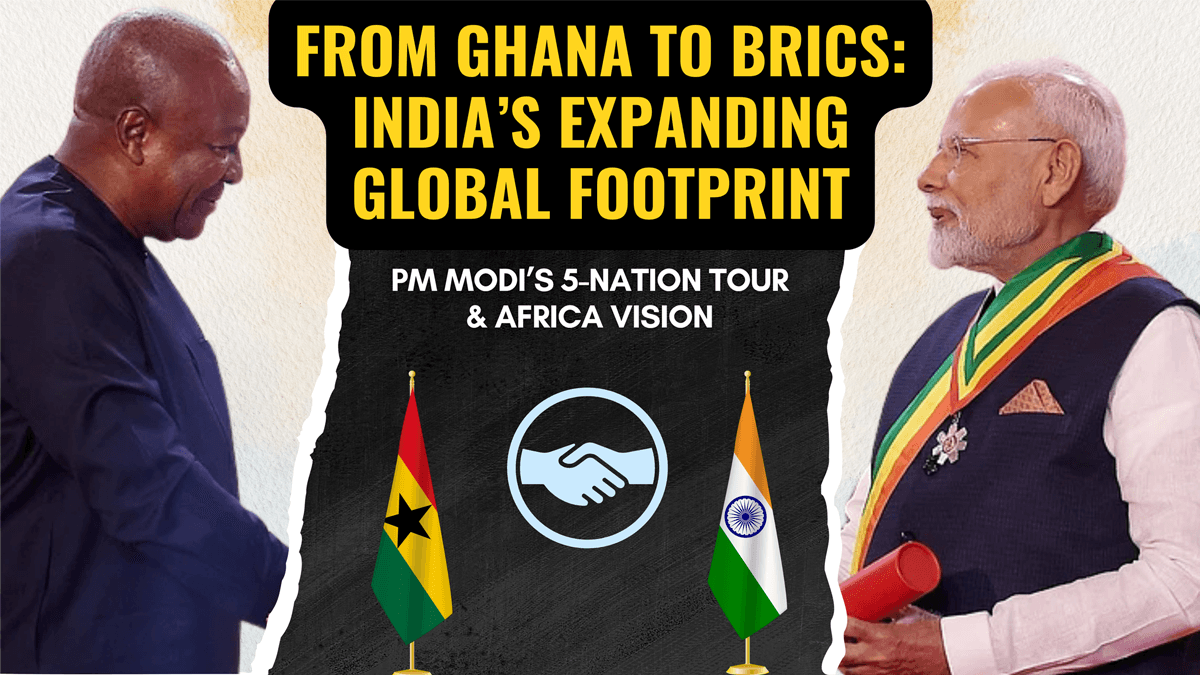
Ghana (July 2–3) – First PM-level visit in 30 years, honoring deep historic ties.
Trinidad & Tobago (July 3–4) – Strengthening bonds in the Caribbean.
Argentina (July 4–5) – Focus on lithium, agriculture, and trade.
Brazil (July 5–8) – Attending the BRICS Summit in Rio, followed by state-level talks.
Namibia (July 9) – Emphasizing natural resource, wildlife, and parliamentary diplomacy.
These visits follow Modi’s June trip to Cyprus and Croatia en route to the G7 summit in Canada
🇬🇭 Focus: Modelling Africa Strategy through Ghana
PM Modi’s rediscovery of Ghana marks a pivotal shift in India’s Africa policy. Here’s why it matters—my perspective as an Indian observer:
Historical & Strategic Roots
India and Ghana’s partnership harkens back to Nehru and Nkrumah’s Non-Aligned Movement days (1957)
Ghana’s reception of Modi—with President Mahama welcoming him at the airport—is symbolic of mutual respect
Economic & Trade Momentum
Bilateral trade grew to US $3.3 billion in 2023, from $1 billion in 2011–12
New agreements aim to double trade in five years and enhance collaboration in defence, healthcare, digital payments, culture, and critical minerals
India’s contribution to Ghanaian infrastructure (like the Tema-Mpakadan railway) and digital systems (UPI/GHIPSS) is a model for South–South cooperation firstpost.com+6narendramodi.in
Security & Governance
Ghana’s stable democracy and regional leadership via ECOWAS make it a strategic anchor for India’s role in West African security
Emerging defence ties and counterterrorism collaboration are also on the agenda
Implications for India’s Broader Africa Agenda
Modi’s Ghana visit is far from symbolic—it’s a blueprint for India’s continental strategy:
Showcase India’s capabilities in technology, pharma, agriculture, and infrastructure, differentiating it from global competitors .
Use Ghana as a gateway into ECOWAS and AfCFTA markets, leveraging trade blocs for wider African outreach
Expand diplomatic presence ahead of the India-Africa Forum Summit, reinforcing Indian leadership in the Global South
Fuel defence exports, peacekeeping, and joint exercises to build strategic depth
My POV: Why This Matters for India
Diversification & Global South Leadership:
Strengthened ties with Ghana show India doesn’t just align with the West—it is a leader in South-South cooperation.Economic Security:
Africa’s natural resources—minerals, energy, agriculture—complement India’s growth ambitions.Strategic Footprint:
Defence, counterterrorism, and infrastructure offer footholds in new regions.Diplomatic Balance:
This tour complements continued engagement in Europe (Cyprus, Croatia) and multilateral blocs (BRICS, G7).
Recent Updates from Ghana Visit
Comprehensive Partnership elevated during PM Modi’s Accra stay
Double trade pact and critical MoUs in defence, digital payments, healthcare, culture, and critical minerals signed
UPI-Ghana interbank linkage confirmed—a boost for instant, low-cost financial integration
Campo in infrastructure & capacity-building reinforced—railways, parliamentary collaboration, digital hubs .
Way Forward
India gains far more than diplomacy in Ghana—it acquires a blueprint for scalable, sustainable Africa engagement. Replicating this playbook—nation by nation—could help India establish a network of reliable partners across the continent. The upcoming visits to Trinidad & Tobago, Argentina, Brazil, and Namibia, alongside BRICS participation, further anchor India’s global positioning.
For India to succeed on the world stage, the Africa strategy must extend beyond rhetoric. Let Ghana be the starting point.
FAQs
2. Which countries were part of the tour?
The itinerary included Ghana, Trinidad & Tobago, Argentina, Brazil (for the BRICS Summit), and Namibia
3. Why was Ghana chosen as the first stop?
This was PM Modi’s first bilateral visit to Ghana in 30 years, aimed at rejuvenating political and economic ties in West Africa
4. What were the key focus areas of the Ghana visit?
Parliamentary address to Ghana’s legislature
Discussions on investment, energy, healthcare, security, and development cooperation
Establishing a vaccine manufacturing hub
Defense and maritime security collaboration
5. Were any agreements signed in Ghana?
While specifics vary, India and Ghana reportedly discussed vaccine hub creation, defense cooperation, and critical minerals, with several MoUs under negotiation
6. How significant is the vaccine hub initiative?
This marks a strategic effort to build vaccine development capacity in West Africa, reinforcing India’s role as a healthcare development partner .
7. How extensive are India–Ghana economic relations?
Bilateral trade is around US $3 billion, with India as a principal buyer of Ghanaian gold. Indian investment (public & private) totals about US $2 billion
8. What is the role of Parliament addresses in this tour?
PM Modi addressed the parliaments of Ghana, Trinidad & Tobago, and Namibia, signifying deep democratic engagement and soft power diplomacy across the Global South
9. How does the Ghana visit fit into India's Africa strategy?
It underscores India’s "Africa First" approach, reinforcing South-South alliances, pushing healthcare, digital payments, defense cooperation, and development support .
10. Was Ghana honored during the visit?
Yes, PM Modi received the Officer of the Order of the Star of Ghana, one of the nation’s highest honors