
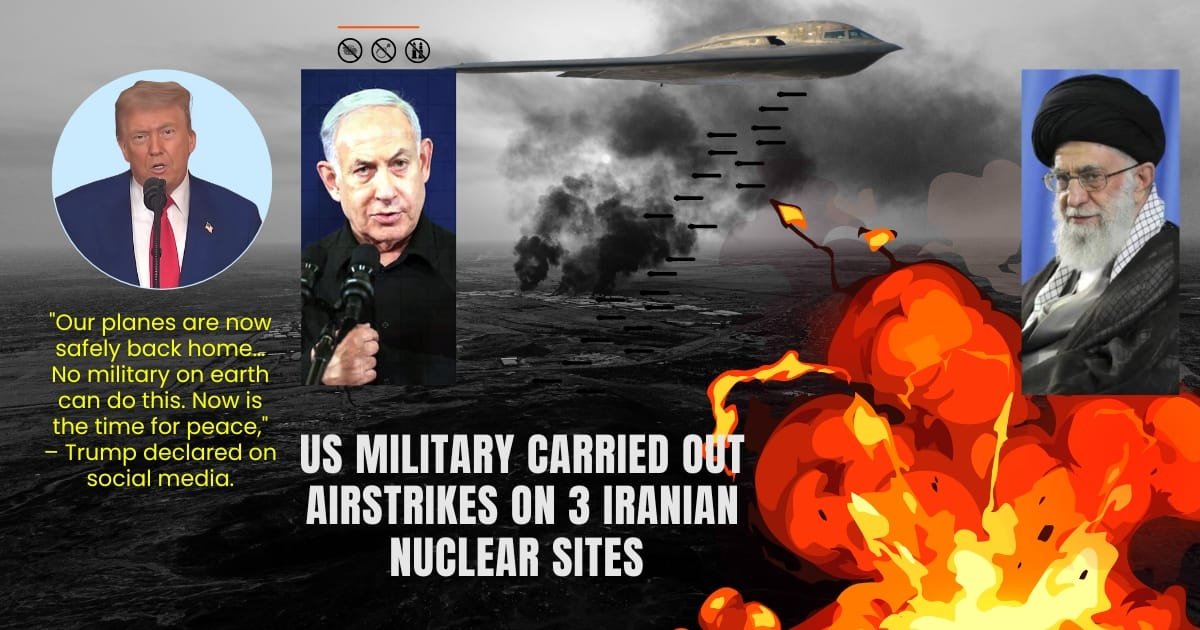
“Peace or tragedy. Many targets remain.” – Donald Trump
In a historic and high-stakes escalation, the United States has launched precision airstrikes on three major Iranian nuclear facilities — Natanz, Fordow, and Esfahan. Former US President Donald Trump, in a nationally broadcast address, hailed the strikes as a “spectacular military success,” confirming the obliteration of Iran’s nuclear infrastructure.
🎯 The Mission: Destroy Iran’s Nuclear Core
Trump’s announcement ended weeks of speculation. The US operation — jointly coordinated with Israeli intelligence — targeted:
Natanz: Iran’s largest uranium enrichment site
Fordow: A deeply buried, heavily fortified facility
Esfahan: A key research and production center
The offensive used B-2 Spirit stealth bombers armed with GBU-57 bunker-buster bombs and over two dozen Tomahawk missiles — a calculated move to disable Iran’s nuclear capabilities with surgical precision.
🛑 Iran’s Response: “We Were Ready”
Iranian authorities admitted the sites were hit but downplayed the impact. Officials claim core materials were evacuated, damage was minimal, and no radiation leaks were detected. However, they condemned the attack as a “grave violation of international law” and vowed “regrettable responses.”
The Iranian Revolutionary Guard retaliated with missile strikes on Israel, reportedly causing casualties and infrastructure damage.
🌍 Global Reactions: From Applause to Alarm
🇺🇸 United States
Trump praised the military and warned Iran:
“There will either be peace, or tragedy beyond what we’ve seen. Many targets remain.”
Secretary of Defense Pete Hegseth confirmed this was a “limited intervention” — not aimed at regime change — with diplomatic channels still open.
🇮🇱 Israel
Prime Minister Netanyahu hailed Trump’s leadership:
“History will remember this as the day terror met steel.”
Even opposition leaders backed the move, seeing it as a deterrent to a looming nuclear arms race.
🇮🇷 Iran
Foreign Minister Abbas Araghchi accused the US of breaching UN protocols, claiming the “time for diplomacy is over.” Iranian President Pezeshkian has since reached out to leaders like Narendra Modi, calling for international mediation.
📞 Modi–Khamenei Phone Call: India’s Call for Peace
Amid escalating tensions and growing international concern, Indian Prime Minister Narendra Modi held a crucial phone conversation with Iran’s Supreme Leader Ayatollah Ali Khamenei.
According to the official statement from South Block:
“Prime Minister Modi expressed deep concern over the evolving security situation in West Asia and underscored the importance of restraint, dialogue, and diplomatic engagement.”
Modi is said to have urged both Iran and its adversaries to de-escalate and return to peaceful dialogue, emphasizing the region’s importance not only for global energy security but also for millions of Indians living in the Gulf.
In response, Ayatollah Khamenei reaffirmed Iran’s commitment to sovereignty and dignity, stating:
“We will not be intimidated by foreign aggression, but we respect the voice of nations like India that advocate peace rooted in justice and mutual respect.”
Both leaders agreed to maintain close diplomatic coordination, and Iran welcomed India’s possible role as a neutral facilitator in backchannel diplomacy.
India, balancing deep ties with both Iran and the United States, has once again positioned itself as a key voice for peace in the Global South.
🌐 World Stage
UN Secretary-General Guterres expressed “grave concern.”
Russia condemned the strike as illegal.
Europe urged restraint while acknowledging Iran’s nuclear threat.
⚖️ What’s Next: Diplomacy or Devastation?
Despite US claims of success, independent verifications (like IAEA) are pending. No radiation spikes have been observed, but access remains restricted.
The Middle East now hangs in balance:
Will Iran escalate? Will global powers intervene diplomatically? Or are we witnessing the dawn of a wider conflict?
✍️ Final Word
This is no longer a shadow war — it’s a full-blown geopolitical showdown. With Trump’s bold airstrike, Iran’s nuclear ambitions have taken a hit. But at what cost?
The choice is clear but dangerous: Diplomacy or Destruction.
FAQs: US Strikes on Iranian Nuclear Sites & Global Fallout
2. What weapons and aircraft were used in the Iran strike?
The operation involved B-2 Spirit stealth bombers equipped with GBU-57 bunker buster bombs, specifically designed to destroy fortified underground sites. Additionally, over two dozen Tomahawk cruise missiles targeted the Esfahan facility.
3. How did Iran respond to the US and Israeli strikes?
Iran condemned the attacks as a violation of international law and claimed minimal damage due to early evacuation. They retaliated by launching missile strikes on Israeli territory, causing injuries and damage, while vowing further action if provoked.
4. What was India’s role or reaction to the crisis?
Indian Prime Minister Narendra Modi spoke with Iran’s Supreme Leader Ayatollah Ali Khamenei, urging restraint and diplomatic dialogue. India emphasized its neutral position and offered to facilitate peaceful solutions while protecting regional stability.
5. What could be the long-term consequences of these strikes?
The immediate outcome is a sharp rise in Middle East tensions. The strikes may temporarily set back Iran’s nuclear program, but risk igniting a broader regional conflict. The world now watches to see if diplomacy or escalation will define the next phase.