
1. Introduction: A Sacred Monument at the Heart of a Conflict
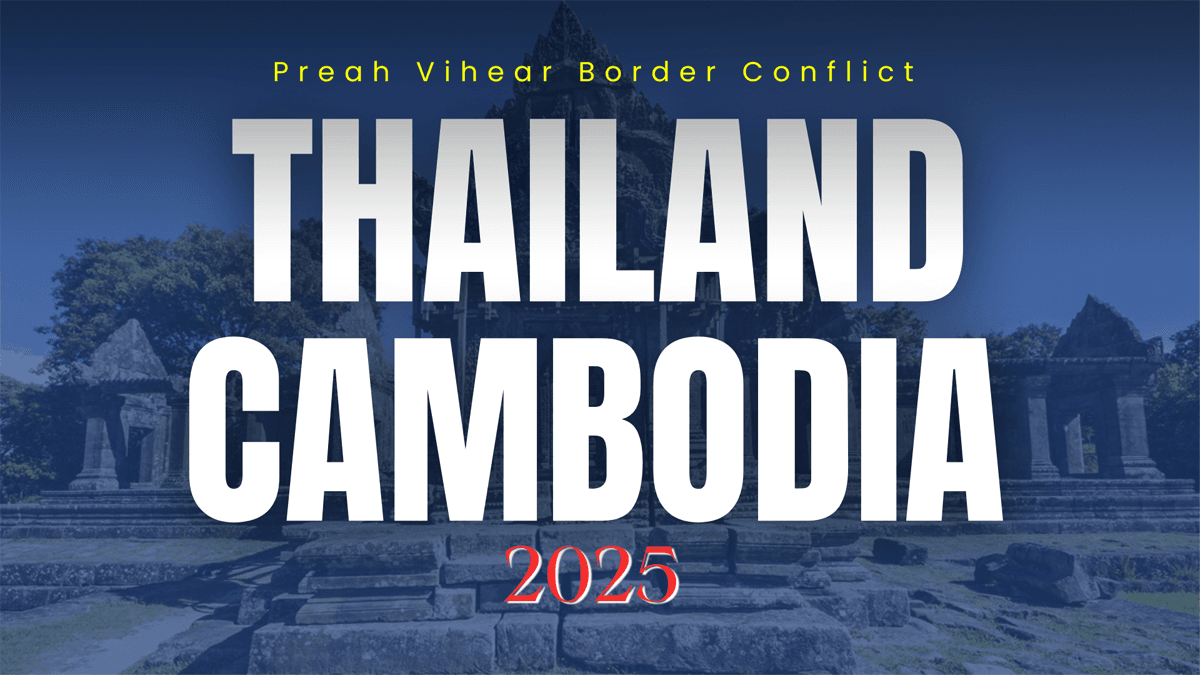
What began as a simmering border dispute between Thailand and Cambodia has erupted into one of Southeast Asia’s most dangerous flashpoints. At least 12 lives have been lost in recent skirmishes, and thousands displaced, as the long-standing territorial feud over the Preah Vihear Temple spirals once again into violence.
But this isn’t merely a quarrel over lines on a map. Preah Vihear—a thousand-year-old Khmer-era temple perched on a dramatic escarpment in the Dangrek Mountains—has become a crucible where national pride, colonial legacies, religious sanctity, and geopolitical rivalries collide. Its stones hold stories older than modern nations, yet today it stands at the crossroads of historical grievance and modern militarization.
2. Historical Context: The Colonial Map That Never Died
At the center of the Thailand-Cambodia conflict lies a deeply entrenched colonial legacy—one that continues to shape the geopolitical landscape of Southeast Asia even in the 21st century. The controversy surrounds the Preah Vihear Temple, a majestic 11th-century Hindu temple dedicated to Lord Shiva, built during the height of the Khmer Empire. While its architecture and cultural significance are indisputably Khmer, its geographical placement atop a steep escarpment along the Dangrek mountain range has made it a lightning rod for nationalist tensions.
The root of the modern dispute can be traced back to the 1904-1907 border agreements between Siam (modern-day Thailand) and French Indochina, which then included present-day Cambodia. As part of these colonial arrangements, France was tasked with mapping the border between the two territories. The resultant 1907 map, prepared unilaterally by the French, controversially placed Preah Vihear within Cambodian territory—despite the only accessible route to the temple lying on the Thai side of the escarpment.
Thailand long contended that this map was invalid, arguing that it violated the original agreement which required the border to follow the watershed line—which would have placed the temple within Thai territory. The two sides engaged in decades of legal and diplomatic back-and-forth, with the issue simmering beneath the surface of bilateral relations.
In 1959, Cambodia brought the dispute before the International Court of Justice (ICJ). After extensive hearings, the ICJ delivered a landmark ruling in 1962, awarding sovereignty of the temple structure itself to Cambodia. The court based its decision largely on the fact that Thailand had tacitly accepted the 1907 map for over five decades, including through actions such as administrative presence and tourism management in the area.
However—and this is the core of today’s conflict—the ICJ ruling left one major issue unresolved: it did not clearly define the boundary of the land surrounding the temple. This omission has proven catastrophic. Both countries interpret the surrounding territory as theirs, leading to overlapping claims, military deployments, and increasingly hostile rhetoric.
Adding to the confusion, in 2008, Cambodia successfully applied to list Preah Vihear as a UNESCO World Heritage Site, reigniting Thai nationalist anger. Many in Thailand viewed the move as a unilateral assertion of sovereignty not just over the temple but over the disputed borderlands. In response, both countries began fortifying their positions, leading to military clashes in 2008, 2009, and a major flare-up in 2011.
Despite a second ICJ clarification ruling in 2013, which confirmed that Cambodia had sovereignty not just over the temple but also its immediate vicinity, ambiguity remains over how far that vicinity extends. The term “vicinity” itself remains undefined, and no mutually agreed-upon border demarcation has followed, allowing tensions to resurface yet again.
Thus, what may appear today as a modern military standoff is in fact the reverberation of a century-old colonial cartographic error—a vivid reminder that unresolved historical grievances can lie dormant for decades, only to reignite with deadly consequences.
3. The July 2025 Escalation: From Skirmish to Full‑Blown Crisis
May 28, 2025: A deadly skirmish in the Emerald Triangle kills one Cambodian soldier, triggering troop buildups on both sides.
June 2025: Cambodia bans Thai media and imports; Thailand responds with border closures and travel restrictions.
July 23–24: A landmine explosion injures Thai soldiers; Cambodia launches rocket barrages, Thailand deploys F‑16 airstrikes; shelling damages homes and schools near historic temples.
Fighting breaks out across more than a dozen border points from July 24; at least 30–43 people die; tens of thousands evacuate.
4. The Human Cost and Economic Toll
Over 300,000 civilians displaced on both sides, with entire villages evacuated.
Thai provinces such as Sisaket subjected to artillery damage; individual stories—like a grandmother returning to her destroyed home—capture devastation.
Thailand reports initial economic damage of 10 billion baht (~$308 million) and allocates 25 billion baht (~$771 million) for relief, reconstruction, tax support, and low-cost credit.
5. Diplomatic Intervention and a Fragile Ceasefire
ASEAN Chair Malaysia, alongside the U.S. and China, mediated talks in Putrajaya on July 28, attended by leaders of both nations.
A ceasefire was declared and came into effect at midnight July 28/29, 2025.
As of July 29–30, the truce mostly holds, though Thailand accuses Cambodia of multiple violations involving small arms fire near Sisaket; Cambodia denies the allegations and calls for independent observers.
August 4 is set for a military meeting under the General Border Committee to discuss compliance and future troop deployments.
6. Geopolitical Stakes and Institutional Failures
The crisis exposed ASEAN’s institutional limitations: strong rhetoric but limited action due to consensus-based decision-making.
The U.S., represented by then-President Trump, linked trade negotiations to a peaceful resolution—and the U.S. ambassador nominee Sean O’Neill has signaled that conflict undermines bilateral alliance credibility.
Analysts agree the clash reflects deeper internal political fissures—from power struggles between the Hun and Shinawatra dynasties to nationalist mobilization.
7. Reimagined Solutions: From Confrontation to Stability
Building on your policy proposals, updated with new frameworks:
A. Robust Monitoring & Mutual Surveillance
Deploy ASEAN-verified drones and satellite systems supervised by neutral observers for transparent border monitoring.
Institute joint patrols and buffer zones, temporarily overseen by third parties, to prevent accidental engagements.
B. Renewed Diplomacy & Legal Clarification
Convene an ASEAN-sponsored peace summit, including international legal and cartographic experts.
Draft a bilateral border treaty informed by tools such as modern geospatial mapping and LIDAR to precisely define jurisdiction.
C. Shared Heritage Governance & Economic Cooperation
Launch a Joint Heritage Council to oversee temple conservation, tourism, and communal benefits.
Develop binational tourism programs, including facilitated transit permits and shared revenue models.
D. Institutional Reform & ASEAN Mechanisms
Activate ASEAN’s Treaty of Amity & Cooperation (TAC) High Council as a permanent mediator.
Mandate rapid response protocols within ASEAN to manage member tensions before they turn military.
8. Conclusion: Preah Vihear as a Test for Regional Peace
For more than a millennium, Preah Vihear has endured dynasties and colonial rule. In 2025, it bore witness to one of Southeast Asia’s most violent border crises in decades. The survival of peace, however fragile the ceasefire, now depends on bold diplomacy, international engagement, and ASEAN’s willingness to evolve. The ghosts of colonial maps cannot keep shaping destinies—leaders must choose to elevate Preah Vihear as a bridge, not a battleground.
9. Frequently Asked Questions (FAQs)
2. Why is Preah Vihear Temple so important to both Thailand and Cambodia?
To Cambodia, it is a symbol of Khmer heritage and national identity. To Thailand, it represents a perceived colonial injustice and loss of cultural pride. Its religious significance, strategic location, and emotional weight have made it a flashpoint for both countries.
3. What triggered the July 2025 escalation?
The immediate triggers included a deadly border skirmish in May, followed by a landmine blast, military buildups, rocket strikes, and F-16 airstrikes in July. Nationalist rhetoric and stalled diplomacy further worsened the situation.
4. How many people have been affected by the conflict in 2025?
Over 300,000 civilians have been displaced, and at least 40 people have died in the July 2025 clashes. Homes, schools, and farmlands were damaged in the crossfire.
5. Is there currently a ceasefire in place?
Yes. A ceasefire was brokered by ASEAN, the U.S., and China on July 28, 2025, and largely holds as of July 30. However, Thailand has accused Cambodia of violations, while Cambodia denies the charges.
6. Why hasn't ASEAN resolved the dispute yet?
ASEAN’s consensus-based structure limits its ability to act decisively during bilateral conflicts. Its credibility is being tested by its inability to enforce peace between its member states.
7. What was the ICJ’s role in the Preah Vihear conflict?
The International Court of Justice ruled in 1962 that the temple belonged to Cambodia. A 2013 clarification reaffirmed Cambodian control over the temple’s immediate vicinity, but failed to define the exact boundaries—leaving the dispute unresolved.
8. What are the proposed solutions to the conflict?
Suggested solutions include ASEAN-monitored drone surveillance, joint military patrols, a new legal treaty defining the border using modern geospatial tools, and a Joint Heritage Council to co-manage the temple and tourism.
9. Why is the conflict drawing international attention?
Preah Vihear sits at a geopolitically sensitive zone. Cambodia is a close ally of China, while Thailand is aligned with the U.S. This raises stakes beyond the region, involving major powers and affecting ASEAN’s credibility.
10. Can tourism ever return to Preah Vihear?
Yes, if peace prevails. Proposals for joint cultural stewardship and two-nation tourism could turn Preah Vihear into a symbol of unity rather than division—but this depends on sustained diplomatic will.