
Introduction
Prime Minister Narendra Modi’s Modi visit Cyprus Croatia G7 Canada Khalistan threats tour from June 15–19, 2025 marks a pivotal moment. Melding diplomatic finesse with geopolitical strategy, the hustle encompassed visits to Cyprus and Croatia—with strong agendas—before culminating in the G7 Summit hosted by Canada. With security threats from Khalistani extremists looming large, the journey illuminated India’s global ambitions and the complexities of modern diplomacy.
In this comprehensive analysis, we’ll unpack:
Why Cyprus? A strategic message to Turkey and Europe
G7 Summit in Canada. Resetting relations, trade, and security amid Khalistan storm clouds
Key insights from Croatia. EU engagement and global positioning
The Khalistan threat timeline. Recent developments, assassination plots, and intelligence findings
Strategic takeaways.
Let’s dive deep.
1.🚩 Strategic Prelude – Modi Visit Cyprus Croatia G7 Canada Khalistan Threats
Cyprus: A Calculated Opening
Modi’s Modi visit Cyprus Croatia G7 Canada Khalistan threats tour began with a historic stop in Cyprus on June 15–16—after a 23-year gap. Cyprus holds EU membership and currently hosts the rotating EU Council presidency. Analysts emphasize multiple angles:
Message to Turkey: Cyprus–Turkey tensions are unresolved; Modi’s visit signals India’s support for Cyprus amid Eastern Mediterranean dynamics
Strategic connectivity: India is eyeing a Mediterranean–Middle East–Europe corridor, and Cyprus offers a portal into these regions .
Cultural and technological diplomacy: From diaspora engagement in Limassol to trade-tech roundtables, the focus was on blending historical bonds with future impetus timesofindia.indiatimes.com.
Cyprus thus functioned as a diplomatic springboard: a message of intent, inclusion, and regional balancing.
2.🌍 Canada G7 Summit – The Diplomatic Reset
2.1.Warming Canada–India Relations
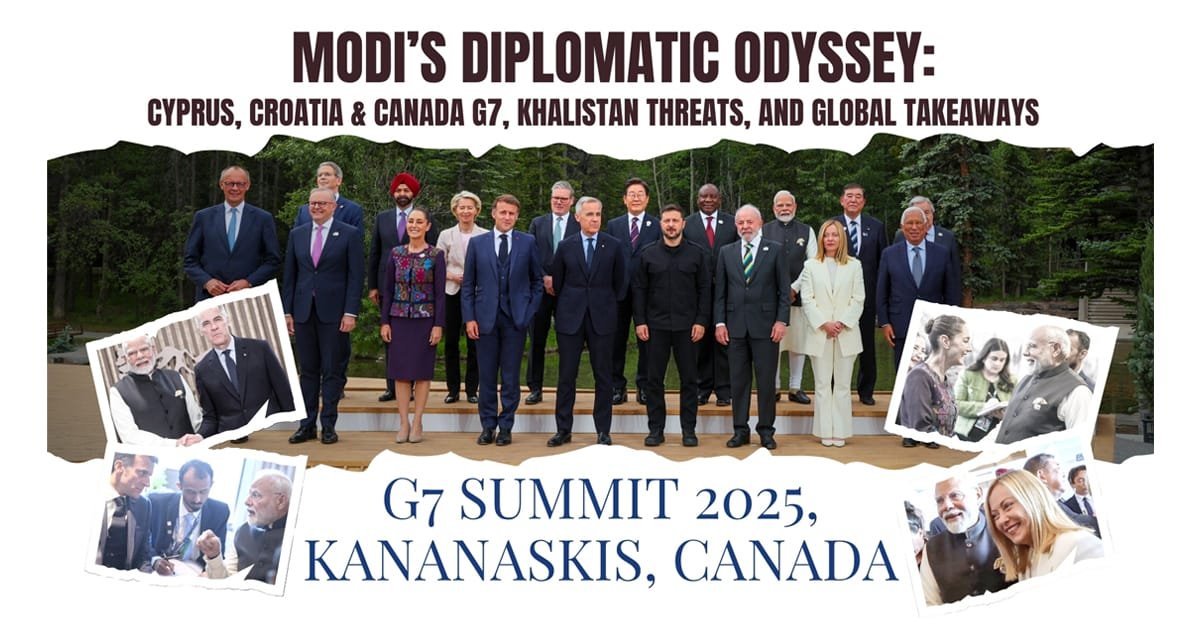
At the core of Modi’s tour was the 51st G7 Summit in Kananaskis (June 16–17, 2025). His presence, extended by Canada’s new PM Mark Carney, signaled a restored relationship after tensions over the 2023 killing of Sikh separatist(terrorist) Hardeep Singh Nijjar.
Carney prioritized national interests over past controversies, inviting Modi and seeking diplomatic normalization ● including reappointment of high commissioners and restarting visa/trade talks
Their meeting produced tangible outcomes: resumed diplomacy, revived trade negotiations, and a renewed law enforcement channel .
Despite a joint G7 statement condemning “transnational repression,” it did not name India explicitly
Thus, the Summit became the platform for a mutual diplomatic reset, balancing strategic priorities with thorny political questions.
2.2. Khalistan Threats: Security in the Spotlight
The trip unfolded against a backdrop of Khalistan extremist threats:
Assassination plot allegations: Canadian journalist Mocha Bezirgan revealed that Khalistani operatives plotted to assassinate Modi during the G7, raising questions about initial delays in his invitation
Community outrage: Many Canadian Sikhs protested Modi’s invitation, decrying Ottawa’s apparent prioritization of diplomacy over justice for victims
Intelligence reports: Canadian Security Intelligence Service (CSIS) confirmed Khalistani extremists using Canada as a hub to coordinate violence in India timesofindia.indiatimes.com
India’s transnational repression claims: Canada accused India of targeting dissidents abroad—including threats to Sikh activists—though these were couched as part of a broader CSIS report listing multiple foreign threats .
Historical context: Deep-seated with roots in 1980s militant activity, evidence exists of plotted attacks against Indian leadership overseas—like the aborted plan against Rajiv Gandhi in 1985 .
Security, therefore, was not a sidebar but a critical dimension of the tour—informing bilateral conversations and shaping public discourse.
3.🌐 Croatia – Bolstering Ties with the EU
Completing Modi’s tour, the stop in Zagreb on June 18 marked the first-ever Indian PM visit to Croatia
Bilaterals with Croatian leaders Andrej Plenković and Zoran Milanović emphasized conflict resolution via diplomacy and peace—echoing his broader message in Cyprus and the G7 .
A strategic nod to India’s growing engagement with the EU, particularly in Central/Eastern Europe, leveraging shared democratic and economic goals .
Croatia represented India’s continued effort to expand strategic partnerships beyond traditional EU centers.
4.📌 Key Takeaways from the Three-Nation Tour
4.1. Proactive Geopolitical Signaling
Cyprus visit sent a message to Turkey and bolstered India’s Mediterranean footprint.
Croatia enhanced India’s reputation as an EU-focused global player.
4.2. Diplomatic Reset with Canada
Carney’s invitation underscored Canada’s shift from ideological caution to pragmatic engagement
Both nations committed to practical cooperation and shared economic, tech, and security imperatives .
4.3. Security at the Forefront
Khalistan threats dominated debate, with CSIS validating Indian concerns and Canada acknowledging intelligence gaps
Historic suspicions—like the Rajiv Gandhi plot—echo anew, demanding vigilant security protocols .
4.4. Strategic Diplomacy Over Ideology
Canada’s pivot by PM Carney shows a tilt toward global engagement over diaspora appeasement
India balanced security priorities with alliance-building, diplomacy, and regional influence.
5.🧭 What’s Next?
Close monitoring of law enforcement cooperation from the Summit—especially around shared intelligence and counterterrorism.
Canada’s decisions on designating Khalistani extremist groups (e.g., Sikhs for Justice) as terrorist entities.
India’s follow-up engagement with EU markets and allied nations, capitalizing on the momentum from Cyprus and Croatia.
6.🎯 Conclusion
PM Modi’s Modi visit Cyprus Croatia G7 Canada Khalistan threats tour was a multilayered diplomatic maneuver. It advanced India–EU ties, reset relations with North America, and elevated security discourse amid Khalistan tensions. The key lesson? In today’s world, diplomacy, defense, and development are inseparable threads of statecraft.
7.✨ Blog Summary for Readers
| Section | Highlights |
|---|---|
| Cyprus | Strategic signaling to Turkey and EU connectivity |
| Canada G7 | Diplomatic thaw with Canada, trade and security reset |
| Security | Acknowledgment of Khalistani threats and intelligence cooperation |
| Croatia | Initiatives to deepen India–EU engagement |
| Takeaways | Pragmatic diplomacy, allied alignment, and vigilance |