
📚 Table of Contents
- Introduction
- Family: The First School of Life
- Faith: The Inner Compass
- Food: Nourishment Beyond Taste
- The Hidden Wisdom Behind the Indian Lifestyle
- Modernization vs Tradition: Conflict or Harmony?
- Global Relevance of Indian Lifestyle Today
- Personal Reflections and Observations
- Conclusion
- Frequently Asked Questions (FAQs)
1. Introduction
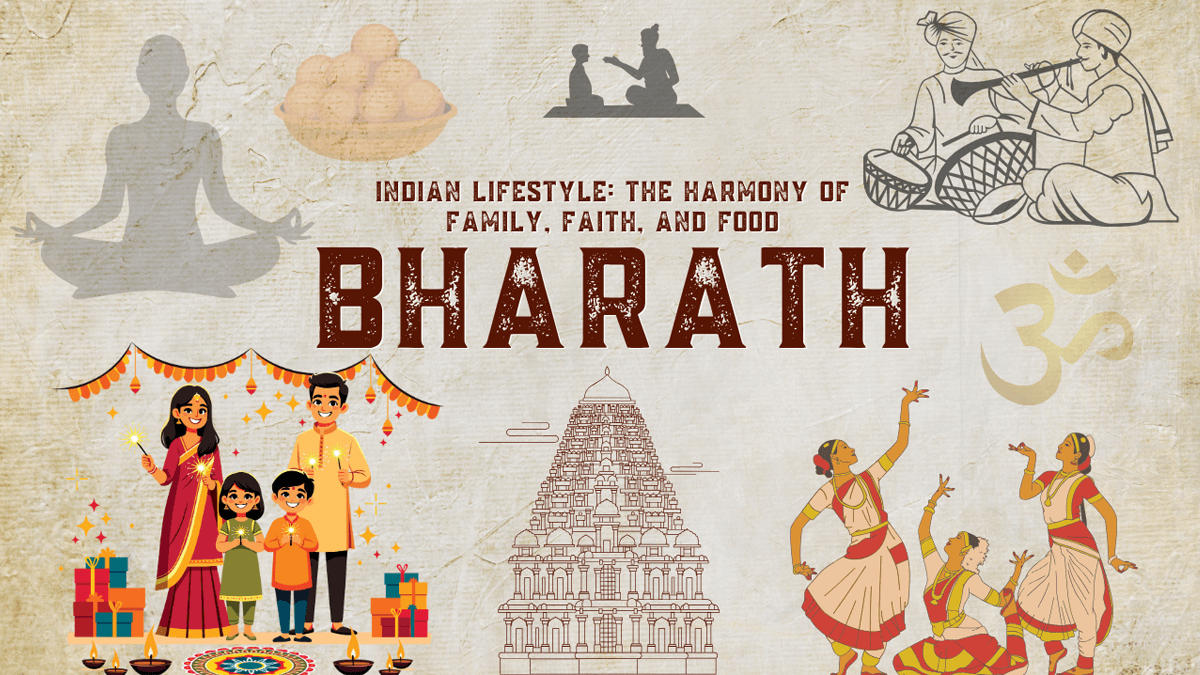
In a world that glorifies speed, efficiency, and rugged individualism, India quietly champions a different way of life—one rooted in interdependence, reverence, and wholeness.
The Indian lifestyle is not about the latest gadgets or trendiest diets. It is about something far deeper and sustainable:
- Family that provides unconditional support
- Faith that brings inner alignment
- Food that heals and connects
This lifestyle isn’t just a cultural identity; it’s a timeless framework for holistic living. As we dive into each pillar, you’ll see why the Indian way of life continues to endure and inspire.
2. Family: The First School of Life
🏡 Multi-generational Living
From the bustling chawls of Mumbai to serene village homes in Tamil Nadu, multiple generations living under one roof remains a common sight. Grandparents pass on stories and sanskaras, while children grow up with built-in teachers and protectors.
“In my home, four generations shared one courtyard. The youngest and oldest often sat together. Wisdom flowed as freely as laughter.”
Support During Crisis
When illness strikes or financial troubles loom, it is the family—not the system—that steps up. From wedding planning to health emergencies, families operate like micro-institutions.
🙏 Elders as Pillars
Touching feet, seeking blessings before big decisions, using respectful suffixes like garu, ji, or ayya — these gestures are not obsolete. They are symbols of continuity and rootedness.
🧣 The Collective Mindset
Rather than “me first,” decisions are often made with “us” in mind. While it may appear restrictive to some, it cultivates mutual accountability and humility.
3. Faith: The Inner Compass
Daily Rhythm and Ritual
Faith structures time. Mornings start with lighting diyas, evenings with aartis, weeks punctuated by fasting days, and years framed by elaborate festivals.
Spiritual Tolerance and Diversity
India is home to countless philosophies: Advaita, Dvaita, Shaivism, Vaishnavism, Jainism, Sikhism—each peacefully coexisting. The norm is acceptance, not enforcement.
Faith as Personal Experience
Here, God is not a concept to fear, but a presence to feel. Be it the Ganga, a Banyan tree, or a flame—the divine is seen everywhere.
Mental and Emotional Wellness
Chanting mantras, walking around temples, attending satsangs—these spiritual practices are proven to reduce stress, increase focus, and build resilience.
4. Food: Nourishment Beyond Taste
Homemade, Heart-made
Despite urban life, many Indians still prefer home-cooked meals. Meals are prepared with love, patience, and ingredients that follow Ayurvedic principles.
Kitchen as Pharmacy
Indian spices are not just for flavor. Cumin helps digestion, turmeric reduces inflammation, ginger boosts immunity. Our kitchen is our first line of defense.
Eating as a Ritual
Food is consumed slowly, often in silence or prayer. The act of offering food (naivedyam) before eating turns nourishment into sacred gratitude.
Community Over Consumption
Whether it’s a wedding feast or a temple annadanam, food is a social binder. It nourishes relationships as much as bodies.
5. The Hidden Wisdom Behind the Indian Lifestyle
- Namaste: A greeting that means “I bow to the divine in you.”
- Cross-legged Sitting: Encourages digestion and calm.
- Ashramas: Life is divided into four stages—student, householder, retiree, renunciate—to ensure balance.
- Festivals: Serve as spiritual resets, community celebrations, and seasonal recalibrations.
These practices are not “backward” but biologically, psychologically, and spiritually enriching.
6. Modernization vs Tradition: Conflict or Harmony?
Many assume modernity and tradition must clash. But in India, they often coexist.
- A girl wearing jeans might still observe Navratri fasts.
- A tech professional may recite Vishnu Sahasranama on the way to work.
- Urban families celebrate Diwali with LED lights, but still perform Lakshmi Pooja.
The key is balance, not blind rejection or blind imitation.
7. Global Relevance of Indian Lifestyle Today
As the world faces:
- Rising loneliness
- Mental health crises
- Climate anxiety
- Processed food epidemics
India’s lifestyle offers answers:
- Joint families counter loneliness.
- Spiritual routines reduce anxiety.
- Plant-based food supports the environment.
- Rituals offer stability in an uncertain world.
8. Personal Reflections and Observations
Growing up in a semi-urban Telugu household, I didn’t fully understand the depth of these traditions. But as life threw curveballs, I found myself returning to them:
- Making chai with my grandmother’s recipe
- Lighting a diya in silence before tough days
- Finding comfort in amma’s rasam when unwell
These are not just memories. They are medicines for the soul.
9. Conclusion
The Indian lifestyle isn’t just a way to survive. It’s a way to thrive.
By holding onto:
- Family that anchors us,
- Faith that uplifts us,
- Food that heals us,
We carry forward a tradition that is as relevant in Silicon Valley as it is in Srirangam.
Let us not abandon it in the race to modernity. Let us refine it, revive it, and rejoice in it—together.
10. FAQs:
2. How does Indian family life influence mental well-being?
Multi-generational families offer emotional support, wisdom sharing, and built-in companionship, which can help reduce loneliness, stress, and mental fatigue in an increasingly disconnected world.
3. Is Indian spirituality relevant in modern life?
Absolutely. Practices like chanting, prayer, temple visits, and festivals help people stay grounded and offer psychological stability, even in the fast-paced modern lifestyle. It’s about experiencing the divine, not just following dogma.
4. Why is food considered sacred in Indian culture?
Food is treated as prasad—a divine offering—connecting nourishment with gratitude. Ayurvedic principles in cooking make Indian meals not only flavorful but also medicinal and preventive in nature.
5. How does the Indian lifestyle balance modernity and tradition?
The Indian lifestyle adapts technology and global exposure without losing its cultural soul. You’ll find people working in tech while fasting on Ekadashi or attending satsangs—it's about harmonizing, not replacing traditions.
6. What lessons can the global world learn from Indian lifestyle values?
The world can benefit from India's emphasis on community, inner peace, environmental respect, and slow living. As burnout and loneliness rise globally, India’s balanced lifestyle offers a sustainable alternative.
7. How can I begin incorporating elements of the Indian lifestyle into my routine?
Start small: Cook at home with traditional ingredients, meditate or chant daily, spend time with elders, and reflect during festivals. It’s about mindful living, not following rules.