
Table of Contents
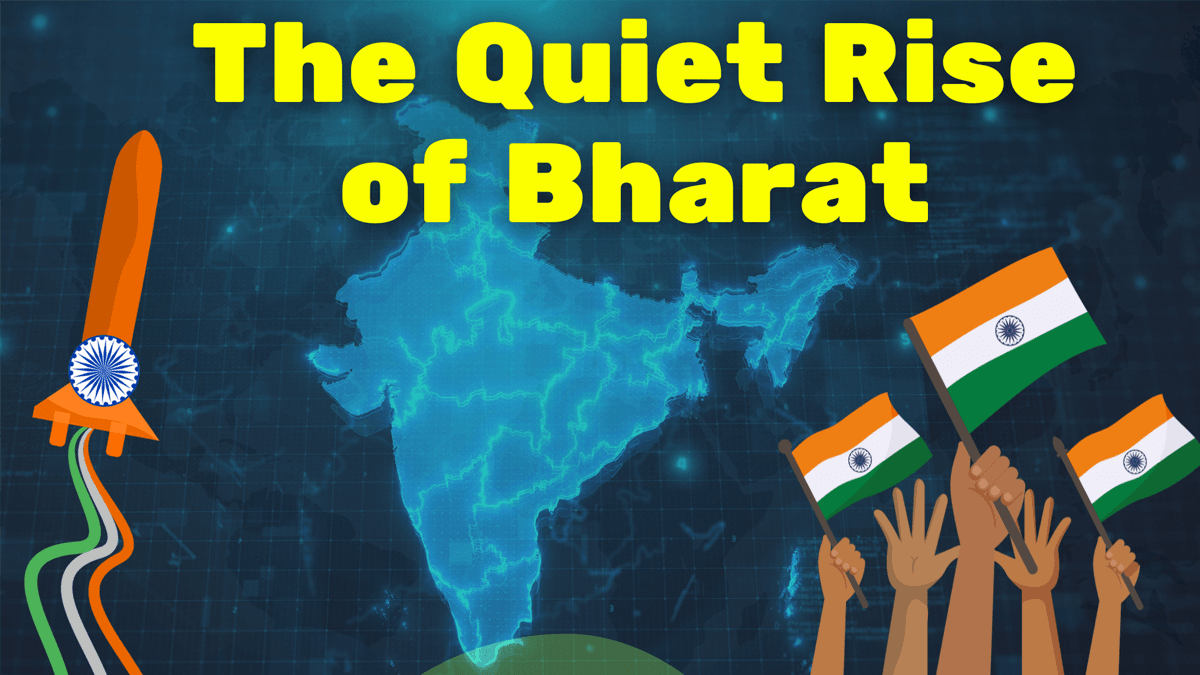
🇮🇳1. Introduction: The Quiet Rise of Bharat
The world is watching as India rises—but few realize that this ascent is not a sudden leap, but a civilizational return. Unlike the explosive growth of some modern powers, India’s rise is marked by a quality that feels almost alien in our fast-paced, short-attention world:
Strategic Patience.
India does not shout. It does not rush. It does not conquer in haste.
Instead, it builds—quietly, slowly, and deliberately—with the confidence of a civilization that has seen empires rise and fall for millennia.
This is not weakness. It is wisdom.
2. Patience as Power – A Civilizational Virtue
In the Indian worldview, patience is not inaction—it is preparation. From mythology to modernity, India has honored the power of waiting for the right moment.
📖 In Our Epics:
Lord Rama accepted exile for 14 years, showing restraint over rage, dharma over desire.
Krishna waited until the very moment Arjuna was ready before delivering the Bhagavad Gita.
Chanakya bided his time, watching empires collapse before laying the foundation for the Mauryan dynasty.
In Indian philosophy, the focus is always on the timeless, not the trendy.
In Yoga, patience manifests in every breath. In Ayurveda, healing is slow but holistic.
In Dharma, right action in the right moment is the highest virtue.
Strategic patience is thus not modern realpolitik—it is rooted in Indian civilizational DNA.
3. India on the Global Stage – A Silent Giant Awakens
India’s global stature in 2025 is not the product of sudden revolutions, but of decades of groundwork.
📈 Key Signs of the Rise:
🌐 Fastest-growing major economy with digital-first innovations like UPI and Aadhaar
🚀 A spacefaring nation with ISRO’s Chandrayaan and Gaganyaan missions
🌏 Diplomatically agile—balancing ties with Russia, US, Iran, and neighbors
🛕 Cultural soft power through yoga, spirituality, cinema, and diaspora influence
This isn’t just a rise in GDP or geopolitical mentions. This is the return of Bharat as a global thought-leader—one who listens more than it lectures.
4. Strategic Patience vs Aggressive Expansion
Let’s contrast India’s approach with that of other global powers:
| Nation | Strategy | Long-Term Result |
|---|---|---|
| 🇨🇳 China | Rapid militarization, debt diplomacy | Global mistrust, internal pushback |
| 🇺🇸 USA | Frequent interventions, cultural export | War fatigue, political polarization |
| 🇮🇳 India | Strategic patience, cultural diplomacy | Stability, trust, long-term alliances |
India doesn’t rush into wars, nor does it impose its will. Instead, it:
Waits for the world to recognize its value
Strengthens grassroots and digital infrastructure
Builds alliances based on shared culture and trade
This isn’t passivity. It’s restraint with resolve.
5. Modern Expressions of Patience
Patience is not just a virtue from our scriptures—it’s visible in India’s most recent achievements.
Space & Science:
ISRO’s journey took decades, from modest launch pads to moon missions.
India didn’t race—it refined, tested, and delivered at 1/10th the cost of others.
Startup Ecosystem:
India’s startup culture slowly matured from outsourcing to innovation.
Now home to 100+ unicorns, this growth was not flashy—it was foundational.
Foreign Relations:
India remains non-aligned, not out of indecision, but by design.
It cooperates with QUAD, BRICS, SCO, and others without choosing sides.
In Crisis:
During COVID-19, India sent vaccines to dozens of nations.
Not with headlines, but with humanitarian humility.
6. India’s Soft Power & Civilizational Confidence
India doesn’t dominate conversations with military might. It speaks with something more lasting: civilizational confidence.
🕉️ India’s Soft Power Channels:
Yoga is now practiced in over 190 countries
Ayurveda is gaining global trust as holistic wellness
Indian cinema & music transcend language barriers
Spiritual tourism draws millions to Varanasi, Rishikesh, Bodh Gaya
Indian diaspora connects cultures across 100+ nations
India doesn’t preach. It offers. And the world is beginning to listen—not because of power, but because of depth.
7. How India Practices Strategic Patience Today
Let’s break down where strategic patience is actively shaping India’s future:
Education & Youth:
Major investment in NEP 2020 and value-based education
Focus on Sanskrit revival, tech-skilling, and global competitiveness
Defense & Security:
Focus on self-reliance (Atmanirbhar Bharat) in defense
Doesn’t provoke neighbors, but strengthens deterrents through tech and alliances
Infrastructure:
Quietly building highways, ports, digital connectivity (Bharatmala, Sagarmala)
5G rollout done with indigenous tech
Environmental Diplomacy:
Championing International Solar Alliance
Leading in climate change negotiations with a Vedic lens on nature
8. The Global Need for India’s Example
Why does this matter to the world?
In an age of instant outrage, rapid militarization, and ideological extremism, India offers something unique:
Spiritual depth without dogma
Strength without aggression
Diversity without fragmentation
The West often values speed and scale. Bharat values timing and truth. As global systems collapse under their own weight, India’s dharmic model of leadership is being noticed.
The world doesn’t just need another superpower—it needs a civilizational guide.
9. Conclusion: The Return, Not the Rise
India’s story is not one of reinvention. It is one of reawakening.
Yes, India is rising economically. But beneath that lies a deeper movement—a civilizational resurgence rooted in Sanatana Dharma, strategic patience, and spiritual clarity.
In a world that rewards noise, India speaks in silence.
In a world that divides, India remembers oneness.
And in a world addicted to speed, India masters the art of waiting.
This is not a sprint. It is a 5,000-year relay—and Bharat is ready to lead again.
10. FAQs
2. What is “strategic patience” in the Indian context?
Strategic patience is India’s unique approach to growth and diplomacy. It means making calculated moves, resisting provocation, focusing on long-term outcomes, and allowing global narratives to align with India's strengths—without compromising national interest or civilizational ethos.
3. How does Indian philosophy influence its strategic decisions?
Indian thought, rooted in Sanatana Dharma, emphasizes timing (kāla), duty (dharma), and detachment (vairagya). This manifests in India's restrained responses, layered negotiations, and resilience under pressure. It's less about aggression, more about alignment with cosmic order.
4. How is India’s diplomacy different from China or the USA?
While China uses economic coercion and the USA relies on military interventions, India emphasizes consensus, cultural diplomacy, and mutual respect. Whether in BRICS, QUAD, or G20, India balances relationships instead of dominating them.
5. Is India’s slow approach a weakness on the global stage?
No. It is a strength in disguise. Strategic patience avoids costly wars, earns global trust, and creates resilient systems. India’s quiet rise is respected for its authenticity and sustainability—unlike empires that peak quickly and collapse just as fast.
6. Can patience be applied in modern sectors like tech and startups?
Absolutely. India’s startup ecosystem, space tech, digital infrastructure, and education reforms are all examples of patience with precision. Progress wasn’t rushed; it was methodically built to endure.
7. What can the world learn from India’s strategic patience?
In an age of polarization, war, and urgency, India offers a model of restraint, harmony, and long-term thinking. The world can learn how to grow without aggression, lead without dominance, and evolve without erasing its roots.