
📑 Table of Contents
Introduction: Conflict Rekindled at the Edge of the East
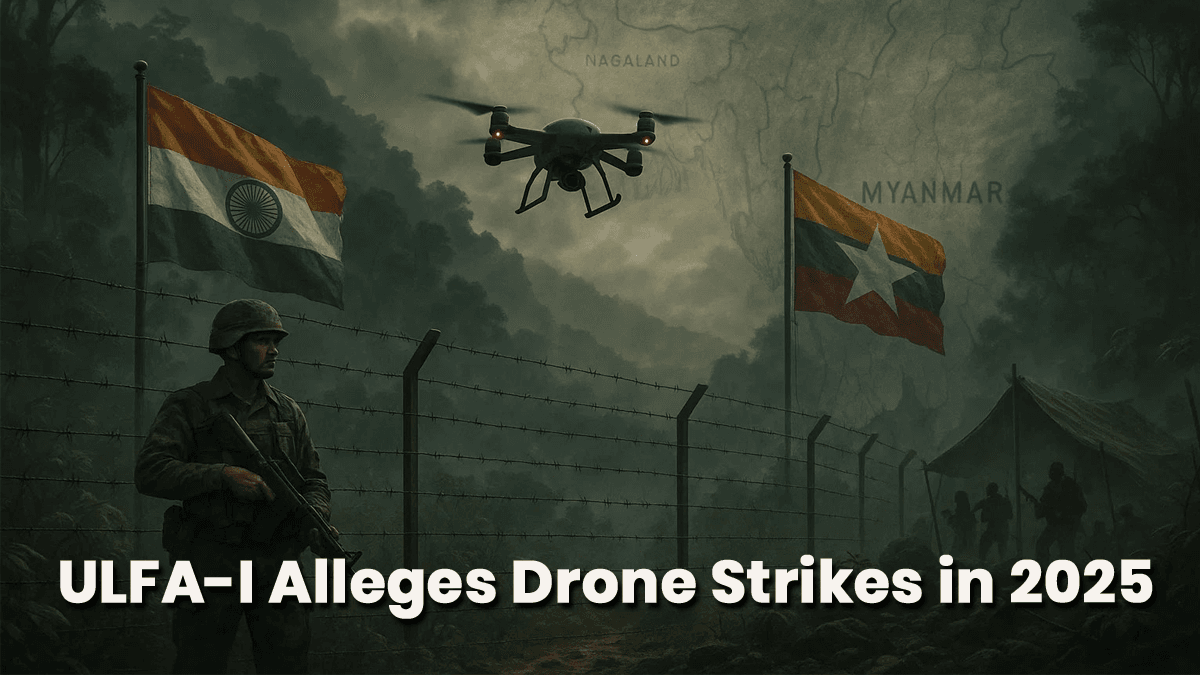
In July 2025, the fragile calm along the India-Myanmar border was shaken once again. The insurgent outfit United Liberation Front of Asom – Independent (ULFA-I) made serious claims that the Indian Army had conducted drone strikes on its hideouts across the Myanmar border, resulting in three fatalities.
These allegations reignited old fears and geopolitical anxieties. While the Indian Army firmly denied launching any such operation, the incident throws light on an unresolved issue that has persisted for decades — the Northeast insurgency, its foreign linkages, and the shifting balance of power in South Asia.
Historical Background: Insurgency, Safe Havens, and Fragile Peace
To understand the current flashpoint, we must look back. The India-Myanmar border, stretching over 1,600 km, has long been a zone of tension. Since the 1980s, groups like ULFA-I, NSCN(K), and PLA have established bases in Myanmar, taking advantage of the porous, forested terrain and limited state control.
Notable Past Events:
1990s – Operation Bajrang & Operation Rhino: Indian forces launched internal operations in Assam against ULFA, forcing the group to relocate camps to Myanmar and Bhutan.
2015 – Surgical Strike in Myanmar: Following the killing of Indian soldiers in Manipur, India carried out a cross-border operation, allegedly killing over 30 insurgents. Though never officially confirmed in detail, this marked a new aggressive stance by India.
Post-2021 – Myanmar Coup Fallout: After the military junta took over Myanmar, lawlessness spread. Indian insurgent camps reportedly expanded their footprint again due to the collapse of local enforcement.
ULFA-I’s Drone Allegations: Fact or Psychological Warfare?
In its recent statement, ULFA-I claimed that armed Indian drones targeted their camps inside the Sagaing region of Myanmar — an area long known for hosting militant safe havens. According to ULFA-I, three of its cadres were killed in the assault.
However, the Indian Army immediately denied these accusations, stating that no operations, manned or unmanned, were conducted across the border during that period.
What’s at Play?
Experts believe this could be:
A disinformation tactic to evoke sympathy and stay in the media spotlight.
An attempt to justify internal casualties by blaming an external force.
A pressure strategy to accuse India of violating sovereignty and invite international scrutiny.
Anti-India Networks in Myanmar: Growing Complexity
Over the years, multiple anti-India elements have been operating from Myanmar’s ungoverned spaces. These include:
Northeast separatist groups (ULFA-I, NSCN factions)
Narco-terrorist syndicates linked to the Golden Triangle
Foreign intelligence proxies suspected of undermining Indian strategic interests
According to reports, insurgents are not just involved in guerrilla tactics, but also in arms smuggling, drug trade, and illegal mining — all of which fund operations against Indian targets.
Example: In 2023, Indian authorities intercepted Chinese-origin assault rifles being transported to Assam through Nagaland, allegedly linked to ULFA-I operatives trained in Myanmar.
The China Factor: Shadow Warfare and Proxy Strategies
While ULFA-I’s claims lack verified evidence, regional analysts consistently warn of China’s indirect role in keeping the Northeast unstable.
Strategic Theories:
China views India’s Northeast as a soft underbelly, where internal disturbances can act as pressure points during larger diplomatic stand-offs.
The “String of Insurgencies” doctrine, though unofficial, refers to Chinese efforts to arm, fund, or shelter India’s separatist groups as part of asymmetric warfare.
Chinese arms regularly surface in seizures from Northeast militants, often traced back to black markets in Yunnan and Laos.
Beijing-Myanmar Nexus:
China has expanded strategic investments in Myanmar, especially in areas like the China-Myanmar Economic Corridor (CMEC). Analysts suspect that anti-India groups may be tolerated or ignored by the Myanmar junta if they do not interfere with Chinese interests.
Drone Warfare: A New Chapter in Border Security?
If India did deploy drones — as ULFA-I claims — it wouldn’t be without precedent. Countries globally are now using drones for:
Surveillance of remote terrains
Targeted strikes on high-value threats
Reducing troop risk and operational visibility
India has already been using Heron and SWITCH UAVs for surveillance along the Northeast. However, the use of armed drones for cross-border strikes would mark a significant escalation — one that India is unlikely to confirm publicly.
Disinformation, Deterrence, or Desperation?
ULFA-I’s drone claim may reflect its desperation to remain relevant. The group has suffered major losses in recent years:
Fewer youth are joining its ranks.
The local population shows declining support, especially in Assam.
Financial pipelines have been disrupted due to increased border monitoring and cyber surveillance.
Yet, their digital propaganda is evolving. Social media is now a battlefield where narratives are shaped, and ULFA-I seems to be investing in psychological operations to portray itself as a victim of state aggression.
Diplomatic Strain: India’s Options and Constraints
India’s ability to act decisively across the Myanmar border has always depended on cooperation from Naypyidaw. But the 2021 military coup changed everything. Myanmar is now diplomatically isolated and less responsive to Indian security concerns.
India’s Policy Dilemma:
Open military actions risk international backlash and China’s reaction.
Inaction emboldens insurgent networks and affects infrastructure projects like the Kaladan Multi-Modal Transit.
Intelligence-driven, covert responses are becoming the most viable option.
Conclusion: A Volatile Future Demands Strategic Clarity
The India-Myanmar Border Conflict of 2025, fueled by ULFA-I’s drone strike claims, reflects a deeper issue: the blurred lines between internal security, foreign policy, and hybrid warfare. Whether the strike happened or not, the narrative itself is powerful enough to reshape perceptions and invite responses from multiple actors.
India must now navigate a dangerous tightrope — balancing regional peace, national security, and geopolitical competition, especially as external powers like China exploit every crack along its eastern frontier.
FAQs:
2. Who is ULFA-I and what are its demands?
ULFA-I (United Liberation Front of Asom - Independent) is a banned separatist insurgent group seeking independence for Assam. It operates from Myanmar and parts of India’s Northeast, often engaging in armed resistance, extortion, and propaganda.
3. Has India ever carried out military operations in Myanmar?
Yes. India is believed to have conducted a covert military strike in 2015 targeting Northeast insurgent camps inside Myanmar after Indian soldiers were killed in Manipur. However, such operations are rarely officially confirmed.
4. Why is Myanmar important in India’s counter-insurgency strategy?
Myanmar shares a 1,600 km porous border with India. For decades, Indian insurgent groups have used its ungoverned regions as safe havens. Cooperation with Myanmar is critical for India to tackle cross-border threats and secure infrastructure projects like the Kaladan corridor.
5. Is China involved in India’s Northeast insurgency?
While there is no direct evidence, multiple intelligence reports and weapon seizures suggest Chinese-origin arms have reached Northeast militants. Experts believe China may use proxy tactics and support anti-India groups as part of broader strategic competition.
6. Are drones commonly used by India for border security?
Yes, India uses UAVs like Heron, SWITCH, and Rustam for surveillance and monitoring in border regions. Armed drone strikes are not publicly confirmed but may be used in high-risk counter-terrorism scenarios.
7. What impact does this conflict have on India-Myanmar relations?
Tensions like this strain India-Myanmar defense cooperation. Since Myanmar’s 2021 military coup, joint counter-insurgency operations have become limited, forcing India to rethink its security strategy in the region.
8. What is India’s long-term strategy for the Northeast insurgency?
India combines military operations, political outreach, development projects, and intelligence-based actions to reduce insurgency. However, regional instability, foreign interference, and lack of cooperation from Myanmar remain major challenges.