

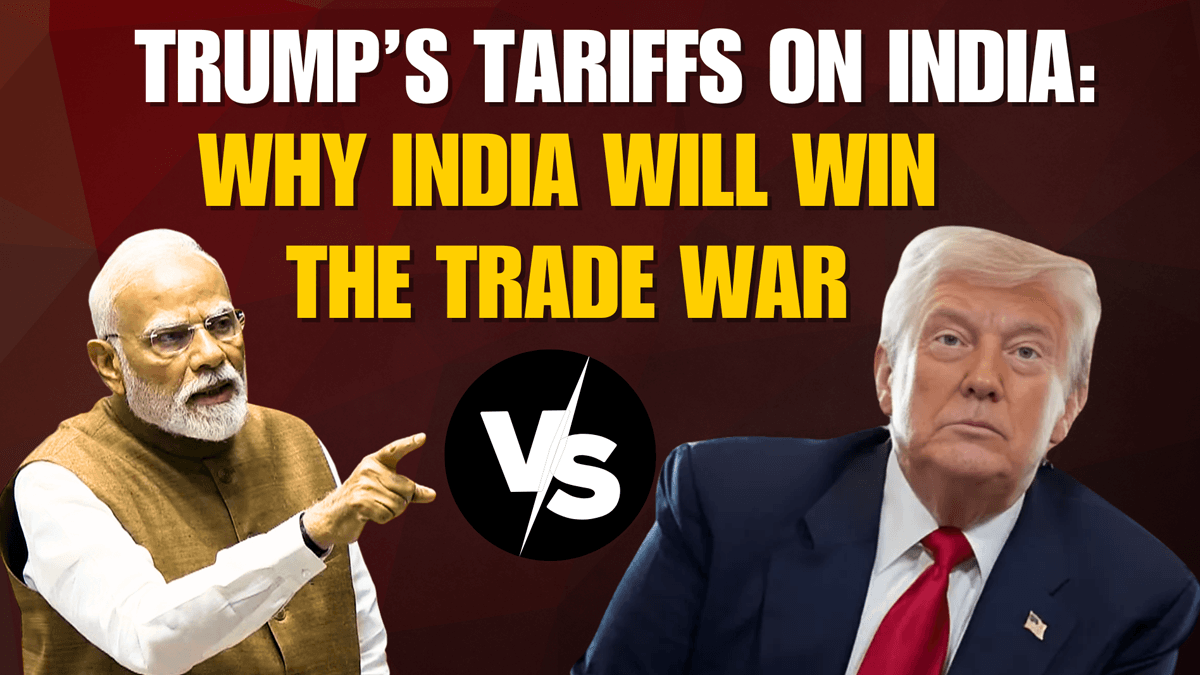
1. India’s Rise Was Never Going to Be Quiet
Before we even begin dissecting Donald Trump’s tariff tantrum against India—35% in total, citing excuses as flimsy as “energy trade with Russia”—let’s call this out for what it truly is: a desperate response to a changing world order.
Because while Trump huffs and puffs about trade balances, India is launching satellites for NASA. That’s right—the world’s most expensive civilian Earth observation satellite, costing a whopping $1.3 billion, just rode piggyback on India’s GSLV-F16 rocket, launched from Sriharikota. Precision-engineered. Impeccably timed. Launched by Indian scientists.
So when the former U.S. President slaps tariffs on Indian goods and calls India “unfriendly,” understand this: he’s not reacting to trade terms. He’s reacting to India’s ascent.
2. What Really Bothers the West: A Rising India
America, especially under Trump’s brand of politics, is watching the global balance of power shift—and it doesn’t like what it sees. Here’s the real image keeping people like Trump up at night: India’s GSLV-F16 rocket launching a NASA payload.
This isn’t symbolic—it’s strategic. It’s a seismic indicator of the power transfer underway. The same country once written off as a service economy is now launching the most sophisticated Earth-monitoring tools ever built.
For decades, space dominance was reserved for a Western elite club—NASA, Roscosmos, ESA. But now, even NASA is leaning on India, not just for launch capabilities, but for technological partnerships. And that bruises the ego of leaders like Trump, who cling to a fading belief in American exceptionalism.
3. The Tariffs: Retaliation or Insecurity?
Let’s get to the meat of the matter: Trump has imposed 25% tariffs on Indian goods, and a projected 10% penalty for buying oil from Russia. That’s a total of 35%, targeting Indian steel, aluminium, and select tech components.
Why?
Trump claims it’s because “India isn’t being a friend.” In other words, India won’t blindly follow Washington’s diktats. Especially not when it comes to choosing energy suppliers or foreign policy autonomy.
But the truth runs deeper. Trump’s trade war isn’t about economic policy—it’s a political tantrum. India is becoming too self-reliant, too global, too influential. And in Trump’s binary worldview—where you’re either subordinate or a threat—that makes India the latter.
4. Modi Government’s Response: Confident, Calculated, Clear
India didn’t panic. It didn’t grovel. And more importantly—it didn’t escalate.
Instead, Prime Minister Narendra Modi addressed Parliament with poise, calling out Trump’s false narratives and diplomatic bluffing. The PM made it clear: India’s military actions, its diplomacy, and its trade policies are sovereign and self-driven. No foreign power can dictate India’s decisions—not even America.
External Affairs Minister S. Jaishankar doubled down in the Rajya Sabha, stating that India had never been asked to stop Operation Sindur, nor did any ceasefire announcement come from the U.S.—as Trump falsely claimed.
Even more telling was the PM’s revelation that U.S. Vice President JD Vance called him twice, warning of a Pakistani threat. Modi’s response? If Pakistan attacks, they will pay a heavy price.
It was a moment of diplomatic maturity, one that subtly but firmly called Trump’s bluff on the world stage.
5. Will These Tariffs Hurt India? Not Much
Let’s be brutally honest: 35% tariffs hurt—but not fatally.
India has spent the last decade future-proofing its economy against just such volatility. Bilateral trade deals have been signed with:
United Kingdom
UAE
Australia
Japan
South Korea
ASEAN bloc
Mauritius, Israel, Sri Lanka, Singapore, Malaysia, and more
Negotiations are underway with Oman, the EU, Canada, and Peru. India is de-risking its economic future by diversifying trade partnerships and stepping into leadership roles in the Global South.
So while Trump’s tariff tantrum may sting, India has already built the cushion to absorb it.
6. PPP Reality: We’re Already Half of America
In terms of Purchasing Power Parity (PPP)—a more accurate reflection of domestic economic muscle—India is a $15 trillion economy. That’s over 54% the size of the United States, whose real GDP stands at about $29 trillion.
Let that sink in.
In PPP terms, India is no longer “developing”—it’s a great power in progress. And this reality—more than any trade imbalance—is what rankles Washington.
India is not looking to be anyone’s junior partner. It’s a peer, ready to shape the rules, not just follow them.
7. India’s Trade Model vs Trump’s Tariff Nationalism
Trump’s worldview is transactional and hierarchical: allies should obey, or pay penalties.
India’s approach is different: mutual benefit without subservience. There is no “big brother” act when India negotiates a trade deal—be it with Bhutan or Britain. This diplomacy of respect is exactly why so many nations are tilting towards India in the new global order.
Trump’s America First policy alienated even allies. India’s Global South First approach is earning partners, not customers.
8. ISRO: From Service Provider to Strategic Partner
Let’s revisit the satellite story. India didn’t just “launch” the satellite. It built half of it. The dual-band Synthetic Aperture Radar system (S-band) was designed and integrated by ISRO. The spacecraft bus? Built by India. The launcher? Indian. The mission coordination? Split between ISRO and NASA.
And what did the world witness?
A flawless launch. A $1.3 billion satellite delivered with world-class efficiency. The Americans didn’t hand us a payload and walk away—they trusted India with the core systems.
This is no longer a story of outsourcing. It’s a story of partnership and parity.
9. Geopolitics of Desperation: Why Trump Really Hit India
Trump is watching a global realignment he can’t control.
Russia and China are drawing battle lines.
Europe is posturing without power.
The Middle East is balancing its ties between Washington and Beijing.
And India? India is rising—on its own terms.
This frustrates Trump, a man used to transactional leverage and threats. India cannot be cajoled, bought, or bullied. Trump’s tariffs are not strategic—they’re symptomatic of his personal insecurity at seeing the American-led order slip away.
10. Jeffrey Sachs Saw It Coming
Economist Jeffrey Sachs, speaking to Tucker Carlson, predicted this exact moment.
“Someday when India succeeds, the U.S. would want to weaken India.”
Carlson, nodding in agreement, added:
“Probably sooner rather than later.”
This is that moment. Trump vs Truth. America vs Reality.
The U.S. cannot stomach the idea of another country rising—not peacefully, not independently, and certainly not without its permission.
11. India Must Lead the Global South
This is the opportunity—and responsibility—before India: to lead the emerging world.
A world that is sick of one-sided diplomacy, colonial leftovers, and Western gatekeeping. A world that wants partnership, not patronage.
India must now:
Strengthen its trade alliances across Asia, Africa, and Latin America
Deepen scientific and technological cooperation with neutral players
Invest in indigenous defense and critical infrastructure
Assert itself at the UN, BRICS, and G20 as the voice of sovereign, multipolar growth
And most importantly—stop expecting validation from the West.
12. Conclusion: Trump’s Move Was Inevitable, But India Will Win
Let’s not pretend this tariff hike was unexpected. It was inevitable.
India’s rise is no longer quiet. It’s not hidden in backroom policy documents. It’s visible in rocket trails over Sriharikota. It’s clear in $15 trillion PPP numbers. It’s loud in Modi’s parliamentary rebuttals. And it’s strong in Jaishankar’s diplomatic spine.
Trump may shout, but he can’t stop what’s coming.
India is winning. Not just the trade war—but the larger war of narratives, independence, and global leadership.
And in this new world, America won’t be the only superpower at the table.
13. FAQs on Trump Tariffs on India & India’s Trade Strategy
2. Why is Trump imposing tariffs on India now?
The tariffs appear to be a reaction to India’s growing global stature, especially in space technology and trade diversification. They are also seen as retaliation against India's oil imports from Russia and its refusal to toe the U.S. line on international conflicts.
3. Will these tariffs severely impact India’s economy?
No. While the tariffs may affect a few export sectors temporarily, India has already diversified its trade portfolio with agreements involving the UK, ASEAN nations, Australia, and more. Its economy remains resilient.
4. What role does ISRO play in this trade-political standoff?
India’s successful partnership with NASA through the NISAR satellite launch, led by ISRO, has spotlighted India's technological leadership. This growing capability challenges U.S. dominance and is a symbolic sore point for Trump.
5. Is the India-U.S. strategic relationship at risk?
Though tensions may rise, India remains a key strategic partner for the U.S. in Asia. However, under Trump’s leadership, transactional politics could overshadow broader cooperation, at least in the short term.
6. How is India countering U.S. pressure from these tariffs?
India is strengthening South-South cooperation, expanding free trade agreements (FTAs), and asserting strategic autonomy. Prime Minister Modi’s leadership is focused on resilience, diversification, and self-reliance.
7. What did Prime Minister Modi say in response to Trump's actions?
PM Modi called out Trump’s bluff publicly in Parliament, revealing that U.S. Vice President JD Vance had warned India of a potential Pakistani attack—underscoring India’s transparency and calling out Trump’s false narratives.
8. What sectors in India might be affected by the U.S. tariffs?
Sectors like textiles, pharmaceuticals, steel, and IT services could see some pressure. However, India’s massive domestic market and growing trade alternatives can cushion the impact.
9. Why does the U.S. see India as a threat now?
India is now the third-largest economy in PPP terms, surpassing the halfway mark of the U.S. economy. Its space achievements, foreign policy independence, and economic growth threaten America's hegemonic position.
10. What is the global perception of India after these events?
India is increasingly seen as a leader of the Global South—assertive, autonomous, and forward-looking. Its ability to stand up to U.S. pressure enhances its credibility in emerging economies.