
Table of Contents (with Anchor Links)
1. Introduction: The UN’s Identity Crisis
🕊️ From global peacekeeper to glorified bystander, the United Nations faces an identity crisis—and India isn’t holding back anymore.
“Multilateral institutions rarely die. They fade into irrelevance.”
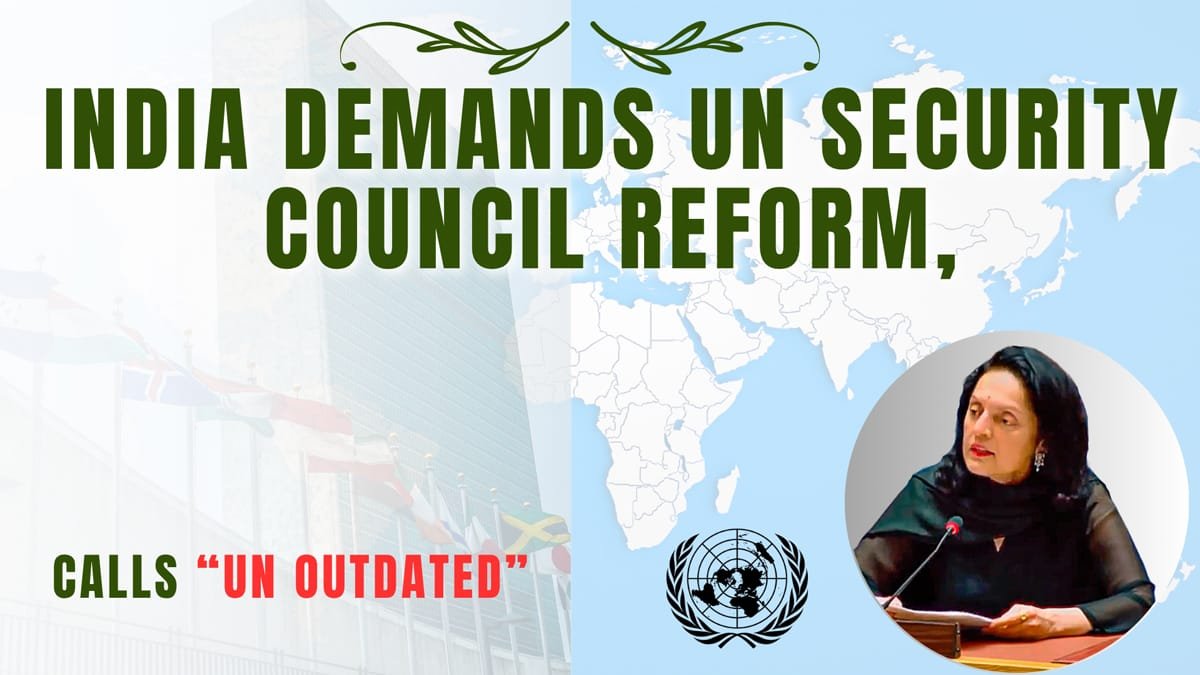
With this piercing observation, India’s Permanent Representative to the United Nations, Ruchira Kamboj, delivered a searing indictment of the global body that was once the pinnacle of international diplomacy. The occasion? An open debate in the UN Security Council on “Effective Multilateralism through the Defense of the Principles of the UN Charter.”
The irony was hard to miss: a debate filled with lofty language about defending a charter the world barely follows anymore.
Let’s call it what it is. The United Nations has become a talking shop—a slow, bureaucratic, outdated forum that fails to prevent wars, stops no military takeovers, and increasingly resembles a glorified Model UN.
2. Mock Diplomacy in a Real World on Fire
Remember those college-level mock UNs? Students roleplay as diplomats, debate global issues, and propose idealistic resolutions. No real-world consequences. No follow-through.
India is now asking: Is the UN itself becoming a mock UN?
Kamboj’s criticism didn’t come from the fringes. It came from India—a founding member of the United Nations and the world’s largest democracy. Her statement represents the voice of 1.4 billion citizens. That’s not just a critique—it’s a reckoning.
3. India’s Indictment: A Voice of 1.4 Billion
India’s rebuke of the United Nations isn’t just another diplomatic complaint—it’s a warning siren from the world’s largest democracy. As a founding member of the UN and a staunch multilateralist for decades, India’s patience is wearing thin. Speaking on behalf of 1.4 billion people, India’s Permanent Representative to the UN, Ruchira Kamboj, didn’t mince words. She accused the multilateral system of shrinking into irrelevance, unable to rise to the occasion when humanity needed it most.
This wasn’t rhetoric—it was reality. During the COVID-19 pandemic, the UN failed to coordinate equitable global vaccine distribution. During Russia’s invasion of Ukraine, the Security Council sat paralyzed. As climate catastrophes escalated, the institution’s response amounted to summits and statements, not solutions.
India’s criticism is not about being excluded—it’s about the UN’s growing inability to deliver. And when a responsible global actor like India starts questioning the system’s legitimacy, the world must pay attention.
4. Three Brutal Truths the UN Can’t Escape
India’s statement at the Security Council debate exposed three uncomfortable truths about the UN—truths the world has long ignored but can no longer afford to.
a. A Thousand Cuts: UN’s Irrelevance
Over the decades, the UN hasn’t failed just once—it has bled out through repeated inaction.
In Iraq (2003), the U.S. bypassed the Security Council to launch an invasion based on false pretenses. The Council’s protests were ignored, and no accountability followed.
In Syria (since 2011), over 500,000 people have died in civil war. Despite massive humanitarian tragedies and chemical weapons use, the Council failed to pass binding ceasefire resolutions because of veto blocks.
In Ukraine (2022-present), Russia—one of the five permanent members—violated another sovereign state’s borders. The very country entrusted to uphold peace became the aggressor, and the Council stood helpless, reduced to issuing symbolic condemnations.
These are not isolated failures—they are symptoms of a system that has lost its teeth.
b. Stuck in 1945: Security Council’s Flawed Legacy
The UNSC is the most exclusive club in global politics, and its membership has remained unchanged since the end of World War II.
Five countries—the U.S., U.K., France, Russia, and China—hold permanent seats and veto power. This reflects a 1945 world order where victory in war meant perpetual authority. But the world has moved on:
Germany and Japan, defeated in WWII, are now economic giants.
India, colonized in 1945, is today a nuclear power, a spacefaring nation, and the fifth-largest economy.
Former colonies in Africa and Latin America now shape global trade, migration, and climate policy.
Yet, none of this is reflected in the UNSC. The world’s most powerful body remains anchored to the past, enforcing an outdated power hierarchy instead of adapting to a multipolar world.
c. No Seat at the Table: Entire Continents Excluded
This is perhaps the most staggering indictment: entire continents—Africa and Latin America—have no permanent representation on the Security Council.
Africa has 54 nations and over 1.4 billion people. It’s the fastest-growing demographic and has borne the brunt of UN peacekeeping operations. Yet, it has no voice at the top table.
Latin America and the Caribbean, home to over 600 million people, are similarly sidelined—even though regional powerhouses like Brazil and Mexico actively contribute to global diplomacy.
Meanwhile, the U.K. and France, each with populations under 70 million, retain permanent seats solely because of their status as victors of WWII. This imbalance is indefensible.
India’s exclusion further adds to this injustice. Not only is it the largest democracy, but it has also contributed the most troops to UN peacekeeping missions and maintains balanced relations with major power blocs.
Representation at the UNSC is not proportional. It’s political. And that needs to change.
5. China’s Veto—The Elephant in the Assembly Room
Of the five permanent members, four support India’s bid for permanent membership. The odd one out? China.
Beijing’s reluctance is no secret. It fears losing strategic dominance and regional clout. But here’s the bitter truth: even China’s obstinance could be overcome—if the West really wanted to make it happen.
Yet, as Kamboj subtly hinted, the West remains comfortable with the status quo. They issue statements of support but avoid confrontation with China. Why? Because in this unequal arrangement, the major powers still get to call the shots while preaching rules to everyone else.
This hypocrisy isn’t lost on India—or the world.
6. The Path Forward: Reform or Irrelevance
India’s demand is not for symbolic inclusion—it’s for a complete overhaul of a structure that no longer serves its purpose. The United Nations Security Council (UNSC), in its current form, is undemocratic, out-of-touch, and increasingly ineffective in addressing today’s complex global challenges. The architecture of 1945 cannot anchor the world of 2025. Reform is not optional—it’s a matter of survival for global governance.
a. Expand the Security Council: No More Empty Seats for Whole Continents
It is outrageous that entire continents like Africa and Latin America have no permanent voice in what is arguably the most powerful decision-making body in the world. These are not minor oversights; they are glaring omissions that delegitimize the UN’s claim of being a global representative forum.
Africa, home to over 1.4 billion people and some of the world’s fastest-growing economies, continues to bear the brunt of international neglect—from conflict zones in Sudan and the Sahel to vaccine inequities during COVID-19.
Latin America, with over 600 million people, has been a silent observer to decisions made without its participation—from global trade frameworks to military interventions in its own backyard.
And then there’s India—a nuclear power, a spacefaring nation, and the most populous country on Earth. India contributes significantly to UN peacekeeping missions and maintains stable relations with nearly all power blocs. To exclude it from permanent UNSC membership is not just unjust; it’s self-defeating.
Representation must reflect reality—not nostalgia for a post-World War II order.
b. End the Veto Tyranny: Stop Letting One Nation Hold the World Hostage
The UN Charter gave the five permanent members—the P5 (U.S., U.K., France, Russia, China)—veto power to prevent unilateral decision-making. But in practice, this power has morphed into a weapon of obstruction.
Russia has used its veto to block any meaningful action on Ukraine, even as its invasion continues to ravage civilian lives.
China routinely uses its veto or threats of veto to protect regimes aligned with its interests, from shielding Pakistan-based terror groups to stalling progress on international investigations into COVID-19 origins.
This ability of one country to nullify the will of the majority of nations is the antithesis of democracy.
India and other reform-minded nations have proposed either abolishing the veto or at least introducing checks and balances—such as requiring two or more permanent members to jointly exercise a veto or allowing a General Assembly override. Without such changes, the veto will remain a license to paralyze global governance.
c. Establish Accountability: A Council That Can Act, Not Just React
The UNSC today resembles a courtroom with judges but no enforcement. Resolutions are passed but rarely implemented. War crimes are committed while the Council debates language. Genocides unfold while statements are drafted. There is no mechanism to enforce accountability—not on member states, not on the P5, and not on the Council itself.
Take the case of Syria, where over 500,000 people have died and millions displaced since 2011. The Security Council, gridlocked by vetoes, has failed to even pass binding ceasefire resolutions.
Or consider Yemen, where a prolonged humanitarian catastrophe continues under the radar, worsened by arms deals between P5 nations and local war actors.
India has proposed building robust accountability frameworks, including:
Mandated timelines for action on urgent humanitarian crises
Independent investigative panels with enforcement capabilities
Mechanisms for the General Assembly to act when the Security Council fails
Such proposals would restore the UN’s credibility as a peacekeeping institution, not just a diplomatic stage.
7. Reform Demands Unity, Not Just Rhetoric
Let’s be brutally honest: reforming the United Nations Security Council is a Herculean task—not because the need is unclear, but because the power to change it lies with those who benefit most from the current structure.
The Permanent Five (P5)—the United States, the United Kingdom, France, Russia, and China—enjoy absolute privilege through veto power. Unsurprisingly, they’re in no hurry to dilute their control. Of the five, China has emerged as the most vocal and active roadblock to India’s entry, driven by geopolitical rivalry and fears of losing strategic edge in Asia.
But the real disappointment lies in the duplicity of the West. Countries like the U.S., U.K., and France routinely express verbal support for India’s permanent membership—but that support never translates into action. No high-level diplomatic efforts. No pressure on China. No binding resolutions. Just convenient soundbites at multilateral forums.
What India needs is not sympathy—it needs solidarity.
That means forming a coalition of the willing:
India, the voice of 1.4 billion.
Brazil, Latin America’s largest economy.
South Africa and Nigeria, continental giants of Africa.
These powers must synchronize their efforts, raise joint resolutions, and push diplomatically to demand reforms. But it’s not just about governments.
Civil society organizations,
independent think tanks,
and a free, assertive media in the Global South
must amplify this call globally. Public opinion must become a geopolitical tool.
This movement isn’t about token representation. It’s about reclaiming global governance from outdated elitism and turning it into a truly democratic, effective, and inclusive system.
The choice before the United Nations is no longer theoretical—it is existential:
Reform, or become irrelevant.
8. India’s Bold Voice in a Timid Assembly
In a chamber known more for polite consensus than candid confrontation, India has emerged as the bold voice the UN didn’t know it needed—but can no longer ignore.
While others tiptoe around the flaws in the UN structure, India has laid them bare. Ruchira Kamboj’s speech at the UNSC wasn’t just a critique—it was a takedown of an institution trapped in the nostalgia of 1945. From calling out the mockery of multilateralism to challenging the veto culture and demanding real representation, India’s message was clear: Enough is enough.
For too long, the international community has tolerated an underperforming United Nations:
A body that couldn’t stop conflicts or wars in Iraq, Syria and around world now in 2025.
- An institution that stayed silent while developing nations were locked out of vaccine access during a pandemic.
But India is no longer waiting.
It is asserting itself, not as a disruptor, but as a rightful stakeholder in shaping the 21st-century world order.
The UNSC was created to prevent the horrors of another world war. Ironically, it now risks becoming the very relic it was designed to replace—an outdated council of victors clinging to power while the world burns.
Diplomacy must evolve.
The UN must evolve.
Or both will perish in the irrelevance they failed to address.
Source:
Firstpost News
9. FAQs:
Q2: What are India's key criticisms of the UN system?
A: India points to three main failures:
The UN’s inability to prevent or resolve modern conflicts (e.g., Ukraine, Syria)
The outdated power structure of the UNSC based on 1945 realities
The lack of representation for Africa, Latin America, and South Asia
Q3: Which countries support India’s bid for a permanent UNSC seat?
A: India’s bid is supported by four of the five permanent members: the United States, France, the United Kingdom, and Russia. China is the only P5 member opposing it.
Q4: What is the “veto tyranny” India refers to?
A: The term refers to how any one of the five permanent UNSC members can block global consensus by using their veto. India argues this paralyzes the Council, often leaving humanitarian crises unresolved.
Q5: What reforms does India propose for the United Nations?
A: India recommends:
Expanding permanent membership to include regions like Africa and Latin America
Limiting or regulating the use of the veto
Creating accountability mechanisms for quicker, enforceable action
Q6: Why hasn’t UN reform happened yet?
A: Reform requires consensus among all five permanent members of the UNSC. Despite public support from some, no serious diplomatic effort has been made to overcome China’s opposition or alter the veto structure.