

📖 Table of Contents
✈️ The Fateful Flight: Air India Flight 171
On June 12, 2025, at approximately 13:39 IST (08:09 UTC), Air India Flight 171, a Boeing 787‑8 Dreamliner bearing tail number VT‑ANB, took off from Ahmedabad Airport, bound for London Gatwick. The aircraft, eleven years old and powered by General Electric GEnx‑1B engines, carried 230 passengers (including children and nationals from India, the UK, Portugal, and Canada) and 12 crew members, under the command of Captain Sumeet Sabharwal (15,600 flight hours, 8,600 on the 787) with First Officer Clive Kunder (3,400 flight hours, 1,100 on the 787) at the controls.
In a matter of 30–35 seconds, the Dreamliner crashed into the hostel block of B.J. Medical College, killing 241 people on board and 19 on the ground, marking 260 total fatalities, with only one miraculous survivor, a British passenger.
What We Knew Immediately
Rescue operations: Within minutes, hospital teams, NDRF, BSF, CRPF, local workers, and municipal resources sprang into action. Ahmedabad Airport was temporarily shut down but reopened later that afternoon .
Black box recovery: Investigators recovered both cockpit voice and flight data recorders, transporting them to AAIB labs in Delhi—voice recorder data retrieved on June 25.
Emergency system activation: Initial probes showed the Ram Air Turbine (RAT) deployed seconds after liftoff—meaning complete loss of engine power or electrical systems prompted emergency power activation.
The Preliminary Report: Engines Starved of Fuel
On July 11–12, India’s Aircraft Accident Investigation Bureau (AAIB) issued its preliminary report, painting a harrowing picture of what transpired mere seconds after takeoff:
At ~8:08UTC, the plane reached maximum recorded airspeed (≈180 knots) and ~650 ft altitude.
Then, within one second, both engines’ fuel cutoff switches moved from “RUN” to “CUTOFF”, effectively starving fuel to the engines.
Though the crew flipped them back to “RUN” and attempted engine restart, the engines did not regain thrust in time, and the aircraft began an unrecoverable descent .
A “MAYDAY” alert was issued, and cockpit voice logs captured:
Pilot 1: “Why did you cut off fuel?”
Pilot 2: “I didn’t do it.”
Black box data confirmed activation of the RAT, reinforcing that both engines had indeed failed.
A Meteoric Crash: Timed by Seconds
Just 3 seconds after takeoff, the fuel shut off, initiating a downward spiral that lasted 29 seconds, culminating in the crash into the hostel The Times of India.
Physical debris analysis verified the fuel switches remained at 5° flap (takeoff setting) and landing gear was still down, showing no time for ascent or glide .
Safety Mechanisms or Sabotage?
This anomaly raised more questions:
Mechanical failure?
The switches are protected by guards and locking mechanisms, deliberately hard to move accidentally.2018 FAA bulletin:
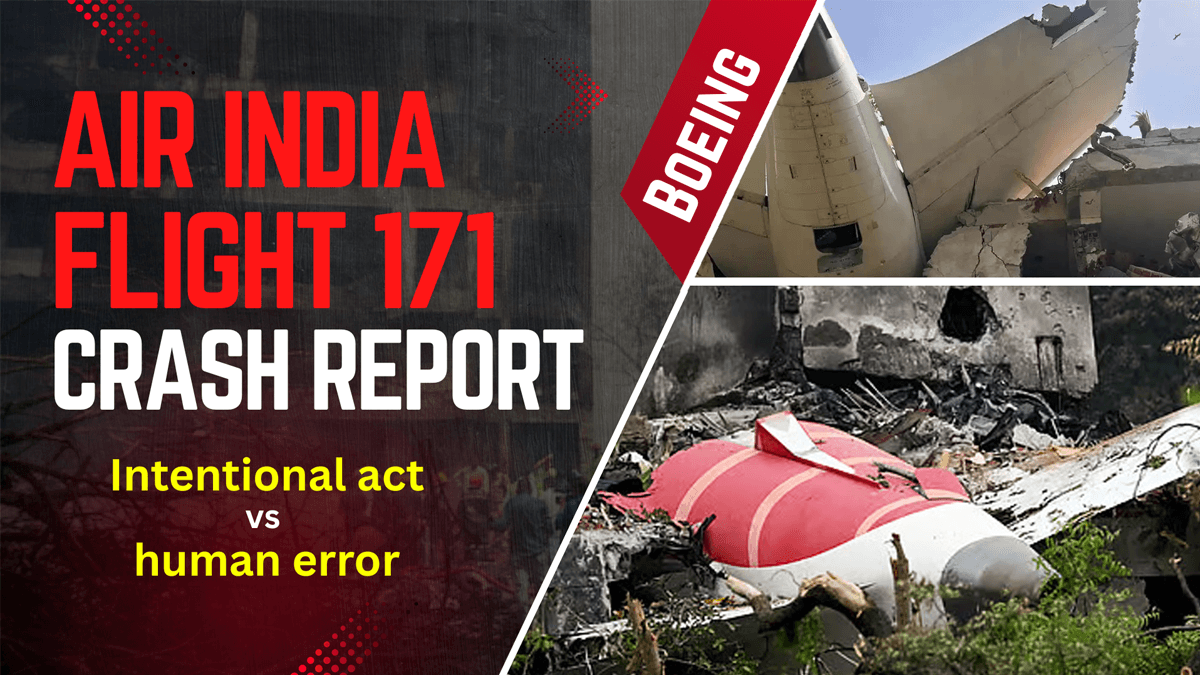
Noted potential issues where locking features could be disengaged — though it was advisory only, not mandatory, and affected older models. The affected aircraft hadn’t triggered a mandatory retrofit, and VT‑ANB was not on the FAA’s list.Intentional act vs. human error:
Aviation experts suggest it’s either intentional, deliberate error, or misidentification of failure, citing that unintentional movement is nearly impossible.“These switches are nowhere near the undercarriage lever … The fuel switches cannot be turned on or off by mistake. They have to be pulled out…” — David Learmount, Unilad
“One would be an utterly extraordinary human error … And the other … an intentional act.” — Tim Atkinson, Sky News
Indian authorities, families, and pilots’ unions are calling for an independent inquiry, concerned the preliminary report fails to clear crucial issues like pilot intent, cockpit dynamics, and possible sabotage.
Stakeholder Reactions
India’s Civil Aviation Minister, Kinjarapu Rammohan Naidu: Expressed that these are preliminary findings, urging patience until the final report is released.
Air India: Offered condolences, Fully cooperative, emphasizing fleet-wide 787 safety checks; temporarily grounding its 33 Dreamliners for intensive inspection Hindustan Times.
Boeing: Offered condolences and assistance, stating it stands ready to aid the AAIB
Pilot unions & victim families: Frustrated by minimal explanations, demanding transparency on cockpit procedures, personnel vetting, and a meaningful final investigation .
Aviation experts: Opinion remains divided — some suggesting intentional sabotage, others emphasizing procedural errors could manifest similarly .
Boeing’s Troubled Safety Narrative
- This incident has reignited concerns over Boeing’s safety culture, a topic already under scrutiny due to past crises. There’s growing unease in the pilot community about “calibrated leaks” from media outlets suggesting pilot error, apparently to shift attention away from Boeing’s role. In fact, as one pilot noted on camera, if the fuel switches were indeed toggled, it would have been per Boeing’s emergency checklist for dual-engine flameout—not an error, but protocol.
- This isn’t Boeing’s first crisis: after the 737 MAX crashes of 2018–19, the company was forced into sweeping redesigns of its MCAS software and crew training procedures. The 787 Dreamliner itself has had safety recalls before—like the 2013 battery fire grounding—reinforcing concerns about whether Boeing’s rapid expansion has compromised thorough engineering reviews . With such a track record, pilots and industry analysts argue it’s premature to assign blame to cockpit decisions when systemic factors—including Boeing’s design, manufacturing, and software integrity—remain underexamined.
🇮🇳 Wider Industry Impact
The crash stalls Tata Group’s modernization efforts at Air India and raises questions about India’s ambition to build an aviation hub like Dubai.
A Parliamentary panel on aviation safety convened to assess existing protocols and regulatory adequacy .
AAIB is under scrutiny for its delayed disclosures, prompting calls for procedural overhaul .
All 787s in India are mandated for immediate safety inspections, focusing on fuel switch modules and cockpit access controls
What’s Next—the Final Report
AAIB’s final report is expected within 12 months, incorporating:
Detailed cockpit voice and flight-data analysis
Psychological assessments of the crew
Technical audit of fuel systems
Human factors review (workload, fatigue, cockpit dynamics)
Based on the evidence, possible outcomes include:
Pilot error (mistaken switch operation)
Deliberate action (intentional shutdown)
Mechanical defect (rare, but check switch locks)
Software/human–machine interface failure
Recommended fixes: cockpit indicators, interlocks, training, mental health screenings.
Survivor’s Account & Human Element
Vishwash Kumar Ramesh, the sole survivor, recounted:
“I just walked out…”
He described disorientation and chaos—power loss, silence, and abrupt descent—reflecting the terror of the final seconds www.ndtv.comHostel residents were having lunch when the aircraft hit—19 lost their lives; the building shattered lives and dreams .
Tata Group & Air India: Announced compensation under Montreal Convention (~₹1 crore per victim), extending relief to ground victims, and pledged to rebuild the damaged hostel
Beyond the Tragedy: Lessons for the Aviation Community
Fuel cutoff switches: Should airlines/designers enforce additional shielding, reposition or redesign to prevent misuse?
Crew resource coordination: Should cockpit duties during takeoff be simplified or roles clarified?
Mental health screenings: Are there sufficient processes to detect psychological stress or intent?
Global audit: Are Dreamliners worldwide equipped with improved safeguards since the 2018 advisory?
Regulatory transparency: Will AAIB reforms lead to better communication and prompt findings?
Public trust: Can Air India and Indian regulators recover confidence through decisive reforms?
Final Thoughts
The Ahmedabad crash of AI‑171 remains a horrifying enigma. The rigid sequence of fuel cutoff followed by immediate descent, cockpit confusion, and lasting questions about intent suggest a tragic confluence of mechanical design and human factor vulnerabilities. Families and professionals alike seek:
- Accountability: was this mechanical, procedural, or personal?
- Reform: improved switch safety, cockpit procedures, mental health safeguards.
- Is Boeing a real culprit? With track record on this company’s past.
- Transparency: a clear, conclusive final report within the 12‑month ICAO timeline.
As investigations continue, the crash stands as a sharp reminder: critical design choices and cockpit trust—not just maintenance and training—may hold the difference between flight and disaster.
FAQs:
2. When did the Ahmedabad crash occur?
The incident happened on June 12, 2025, just seconds after Air India Flight 171 took off from Ahmedabad Airport.
3. Who survived the crash?
A British passenger—Vishwash Kumar Ramesh—was the sole survivor among 242 on board. His account is a key human element in the investigation.
4. What is the Aircraft Accident Investigation Bureau (AAIB) report saying so far?
The AAIB’s preliminary report confirms fuel starvation from both engines within one second of each other. Both pilots attempted restart, but it was too late.
5. Was this mechanical failure or pilot error?
The preliminary findings don’t definitively identify whether it was mechanical, intentional, or mistaken action. The report notes that the fuel switches are designed to be difficult to operate.
6. What safety measures are being taken now?
Air India is grounding all Boeing 787 Dreamliners in India for inspections.
AAIB is reviewing cockpit switch design and access, and mental‑health screening protocols.
7. When will the final AAIB report be released?
Typically issued within 12 months, the final report is expected by mid‑2026, with detailed analysis and recommendations.
8. What could the final report recommend?
Possible outcomes include: redesigning fuel switch safeguards, enhanced crew training, cockpit indicator systems, and mental‑health protocols for pilots.
9. How is Boeing and the aviation community responding?
Boeing is cooperating fully. Aviation unions, experts, and families are demanding transparency, engineering checks, and independent oversight.
10. How can I stay updated on this investigation?
Keep an eye on official AAIB updates, Air India communications, and credible aviation news sources. We’ll update our post as new information becomes available.