
Table of Contents
- The Missing Ministers: A Key Element in China’s Political Crisis
- Xi Jinping Absence from BRICS and the Political Power Struggle
- China’s Domestic Turmoil: A Brewing Political Crisis
- Delegation or Distraction Amid a China Political Crisis?
- Signs of Succession: Who’s Next in Line?
- Factionalism Within the Party: Brewing Beneath the Surface
- The Role of the Military: A Double-Edged Sword
- International Implications: Global Ripples from Beijing
- Looking Ahead: 2027 and Beyond
- Conclusion: A Nation at the Crossroads
- Frequently Asked Questions
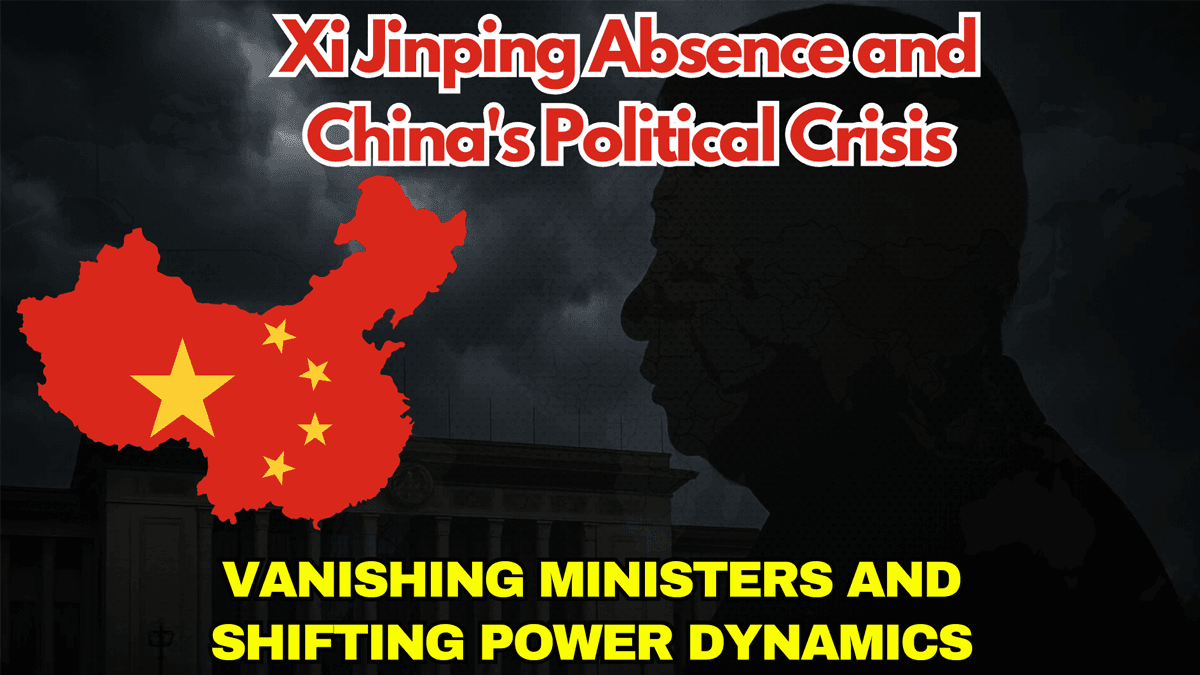
Beijing, China – A mysterious wave of disappearances, an unexpected absence by President Xi Jinping, and quiet but powerful regulatory shifts—China’s political landscape is undergoing dramatic tremors. The world’s second-largest economy, ruled for over a decade with an iron grip by Xi, is now drawing global attention for all the wrong reasons. Top military and government officials have gone missing. The Defense Minister, Foreign Minister, Rocket Force generals—all have vanished without clear explanations. And now, for the first time in 12 years, Xi himself skipped the BRICS Summit. The signal is clear: something is brewing behind the walls of Zhongnanhai.
This article explores these unsettling developments and what they might mean for China, the Chinese Communist Party (CCP), and the world at large.
The Missing Ministers: A Key Element in China’s Political Crisis
China’s Defense Minister Li Shangfu was last seen on August 29, 2025, when he delivered a keynote speech at the China-Africa Security Summit. Since then, he’s missed high-level meetings with Vietnam and Singapore, citing “health reasons”—a now-familiar euphemism in Chinese political theatre.
It’s eerily reminiscent of the case of Qin Gang, the former Foreign Minister. He vanished from public view after meeting a Russian delegation in June. Expected to attend the ASEAN Summit in July, he was quietly replaced by Wang Yi, without explanation.
Add to this the sudden absence of top Rocket Force generals—Li Yuchao and Liu Guangbin, who once managed China’s nuclear arsenal—and the pattern becomes undeniable.
The Playbook:
- Sudden disappearance from public life
- Cancellations of key diplomatic engagements
- Official silence or vague mentions of “health”
- Quiet replacement or removal
And behind it all? A tightening grip by Xi Jinping, executed under the guise of anti-corruption.
Xi Jinping Absence from BRICS and the Political Power Struggle
Xi’s no-show at the BRICS Summit in Rio de Janeiro in 2025 was more than symbolic. For the first time since becoming president, he allowed Premier Li Qiang to represent China on a global stage.
This move, coupled with the Politburo’s quiet passage of new Communist Party regulations, has ignited speculation: Is Xi finally preparing for succession? Or is this merely a tactical move to deflect blame as China faces internal crises?
The new rules published in Xinhua require party organs to plan, deliberate, and oversee major policies—responsibilities that Xi once tightly controlled. Some see this as the first sign of institutional rebalancing in over a decade.
China’s Domestic Turmoil: A Brewing Political Crisis
Internally, the situation is dire:
- Youth unemployment reached 15.8% in April 2025
- The property sector is collapsing
- Local governments are drowning in debt
- Consumer confidence is at an all-time low
- Global backlash is mounting over China’s trade practices
The economic engine that once powered the world is sputtering. Analysts believe Xi’s strategic withdrawal from the global stage might be an effort to focus inward—restabilizing the domestic front before reasserting China’s international position.
Delegation or Distraction Amid a China Political Crisis?
Xi’s centralization of power over the past decade was absolute. His anti-corruption drive eliminated rivals, and term limits were abolished to ensure his indefinite rule.
So why loosen the reins now?
Some believe Xi is distributing authority to shield himself from political fallout. By allowing the Party’s coordinative institutions to take the lead, he shares both responsibility and blame. Others see it as a controlled transition, laying the groundwork for a successor in 2027, when Xi turns 75.
Signs of Succession: Who’s Next in Line?
For years, Xi has refused to name a successor—breaking with post-Mao traditions of collective leadership. But recent moves suggest that Beijing is carefully crafting a path forward.
Possible Contenders:
- Li Qiang – Premier and de facto foreign representative
- Wang Yang – A reformist voice with deep experience
- Zhang Youxia – Military leader with factional ties
- Ding Xuexiang, Wang Huning, Zhao Leji, Li Hongzhong – Powerful Politburo members with varying degrees of proximity to Xi
Whether Xi steps down in 2027 or seeks a fourth term, the lack of a clear heir makes China’s political future highly unpredictable.
Factionalism Within the Party: Brewing Beneath the Surface
Xi’s dominance has not gone unchallenged internally. His anti-corruption crusade has created enemies. Insiders whisper of growing factionalism—a resurgence of intra-party politics suppressed during Xi’s rule.
The sudden disappearances of high-ranking officials may be less about discipline and more about consolidating control ahead of a fragile transition. These moves suggest Xi is balancing on a razor’s edge—between control and collapse.
The Role of the Military: A Double-Edged Sword
The People’s Liberation Army (PLA) pledges loyalty not to the state, but to the Communist Party—a structure that has historically ensured political compliance.
Yet even within the military, cracks are emerging. The disappearance of the Rocket Force leadership points to corruption, yes, but also to possible dissatisfaction or independent power centers. Xi’s personal oversight of the military purge underscores how fragile his command might be.
International Implications: Global Ripples from Beijing
Xi’s silence on the global stage has raised concerns in international circles. China’s behavior—both in diplomacy and economics—is being reexamined:
- Dumping practices are under fire from global markets
- Western powers are decoupling from China
- Regional tensions in Taiwan, South China Sea, and with India remain unresolved
Any sign of instability in China sends ripples worldwide. A peaceful transition could offer hope, but a power struggle at the top of the world’s second-largest economy could trigger global uncertainty.
Looking Ahead: 2027 and Beyond
The 20th Party Congress in 2027 could be a pivotal moment in modern Chinese history. If Xi seeks another term, it would confirm his continued dominance. But if he steps aside—voluntarily or under pressure—the world will witness China’s first real power transition in decades.
Will it be smooth? Or chaotic? Will reformist forces reemerge, or will Xi’s legacy continue under a loyal successor?
In a country where whispers often carry more weight than speeches, the signs are unmistakable. Something is shifting.
Conclusion: A Nation at the Crossroads
As high-profile officials vanish and the supreme leader retreats from the spotlight, China appears to be entering a critical phase of recalibration. Whether this is the dawn of a new era or the prelude to deeper authoritarianism remains to be seen.
For now, the world watches, waits, and wonders: Where is Xi Jinping? And what will the future of China look like without—or beyond—him?
FAQs:
2. Are Chinese ministers really disappearing?
Yes, several high-ranking officials including Defense Minister Li Shangfu, former Foreign Minister Qin Gang, and Rocket Force generals have vanished from public view in 2025. Many were later quietly removed from office.
3. What are the new Communist Party regulations passed in 2025?
The regulations emphasize collective decision-making by party organs, potentially limiting Xi's direct control over every policy. This shift suggests a recalibration of internal power dynamics.
4. Is China preparing for a leadership transition?
There are growing signs that Xi may be preparing for a transition by 2027. However, no successor has been named, leading to speculation and uncertainty within and outside China.
5. How is China’s economy influencing political shifts?
With youth unemployment surging, property markets collapsing, and foreign trade under pressure, Xi may be delegating authority to manage internal dissent and deflect blame for economic woes.
6. Could Xi Jinping seek a fourth term in 2027?
It’s possible. While some believe he may orchestrate a transition, others suggest he might continue his reign if the political environment remains favorable.
7. What impact could these developments have globally?
Instability at the top of China’s leadership could affect global markets, security policies in the Indo-Pacific, and international diplomatic engagements.