
Table of Contents
1. Introduction
“Pooja? That’s for my grandma.”
“Why spend time lighting lamps when I can just sit and meditate or journal?”
If you’ve heard—or said—these lines, you’re not alone. In our modern lives filled with deadlines, distractions, and a drive for efficiency, rituals like pooja may seem old-fashioned or redundant.
But here’s the truth:
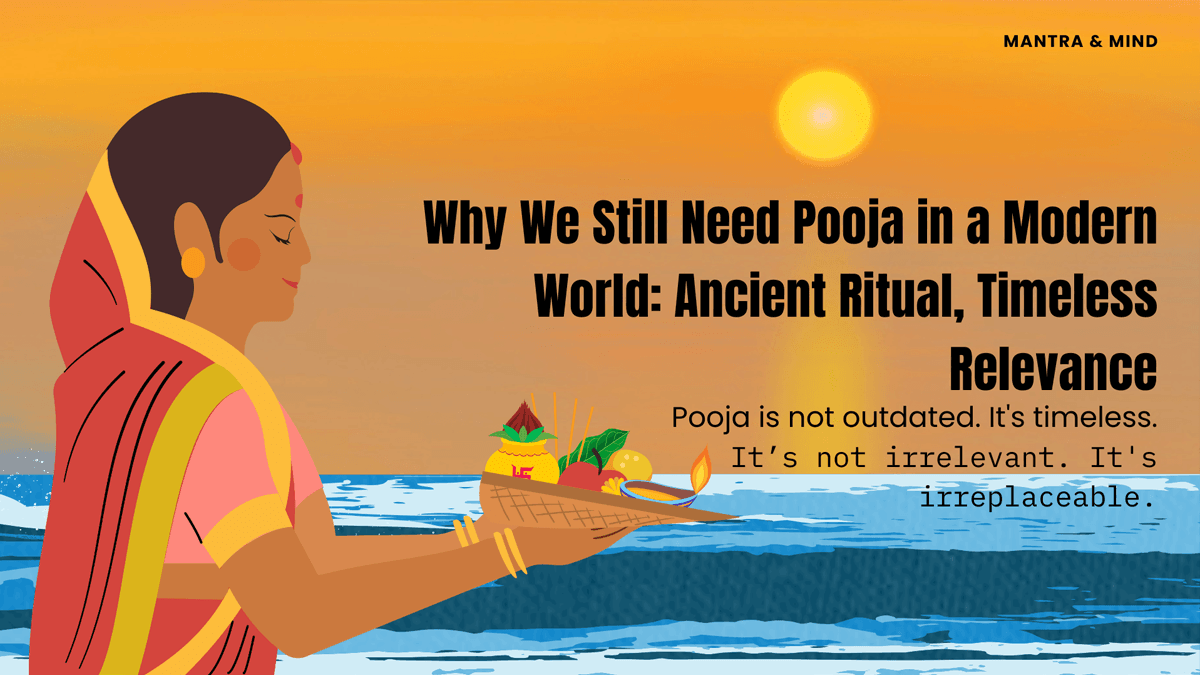
Pooja is not outdated. It’s timeless.
It’s not irrelevant. It’s irreplaceable.
In fact, in a world overwhelmed with screens, stress, and speed, we need rituals now more than ever. Pooja offers something rare: stillness, intention, and sacred rhythm—something your nervous system craves but rarely receives.
Let’s explore why this ancient practice deserves a central place in our modern lives.
2. What Is Pooja, Really?
Pooja (or Puja) is often misunderstood as a religious performance meant to please deities. But that’s only the surface.
At its core, Pooja is a symbolic conversation with the divine—a physical expression of an inner posture: humility, gratitude, reverence.
Pooja can be:
A grand ritual in temples
A five-minute diya lighting at home
A silent offering of water with a mantra
Pooja Means:
Inviting divine presence into your space
Honoring the sacred within and around you
Aligning your inner energy with the universal rhythm
The Sanskrit word “Puja” is derived from “Pū” (to purify) and “Ja” (to awaken)—meaning: to purify through awakening awareness.
3. Psychological & Emotional Benefits of Pooja
Even if you see yourself as more spiritual than religious, you can’t ignore the science-backed psychological benefits of ritualistic pooja.
🔹 a. Creates Mental Boundaries
Lighting a lamp or chanting a mantra tells your brain: “It’s time to pause, reflect, realign.” It sets sacred boundaries in a day full of chaos.
🔹b. Builds Inner Discipline
Rituals bring structure. Daily pooja—even if just for 5 minutes—anchors your routine and creates predictable inner peace.
🔹 c. Reduces Anxiety
Sounds of bells and mantras, scent of incense, repetitive mudras—they activate the parasympathetic nervous system (rest-and-digest mode). This is powerful stress therapy.
🔹 d. Activates Gratitude & Letting Go
Even small offerings remind you of abundance. You shift from “what I lack” to “what I have to give.” This rewires your emotional state toward joy.
4. Pooja as an Energetic Practice, Not Just Religious
You don’t have to be religious to feel pooja’s effects—because it works on energy, not dogma.
How?
🔥 Lighting a diya engages the fire element (Agni), which purifies space and mind.
🔊 Mantras and bells release sound vibrations that resonate through your nervous system.
🌺 Offerings are symbolic acts of non-attachment—they help dissolve ego and open the heart.
In this way, pooja is like spiritual acupuncture. You direct energy intentionally using physical symbols—no belief system required.
5. Pooja vs. Meditation – Harmony, Not Conflict
Some people ask, “Why perform rituals when I already meditate or do yoga?”
Here’s how they differ (and work together beautifully):
| Practice | Focus | Function |
|---|---|---|
| Pooja | Devotion, offering, surrender | Activates heart (Bhakti) |
| Meditation | Observation, inner silence | Calms the mind (Jnana/Antar Mouna) |
| Together | Integration | Balances emotion + awareness, action + stillness |
You don’t have to choose.
You just have to understand how each serves your inner ecology.
6. How to Make Pooja Fit Modern Lifestyles
You don’t need a large altar or Sanskrit fluency to do pooja. Start small. Here are minimalist, meaningful ways to incorporate it:
🌞 Morning Rituals
Light a diya or candle and sit for 2 minutes in silence.
Offer one flower, tulsi leaf, or even a spoon of water.
Chant a simple mantra (like Om Namah Shivaya or Gayatri Mantra) 3–9 times.
🛏️ Evening Wind-Down
Light incense while playing soft bhajans or instrumental.
Reflect on your day with gratitude.
Offer all worries to the divine—mentally “handing them over.”
It’s not about perfection. It’s about presence.
Even 3–5 minutes a day is enough to reset your energy.
7. Why It Matters in the 21st Century
In a world of hyper-productivity, pooja teaches sacred slowness. In a society drowning in distraction, it teaches focused presence.
Here’s why pooja is more important now than ever:
🔋 Burnout Recovery
Rituals rewire your nervous system and restore mental stamina.📵 Digital Detox
Pooja becomes screen-free time where your attention returns inward.🤝 Family Bonding
When done together, it becomes a shared moment of reverence and rhythm.🙏 Cultural Continuity
Practicing pooja keeps alive the wisdom of your ancestors—passed from heart to heart.
In essence, pooja is rooted minimalism—the most beautiful antidote to modern overload.
8. Personal Reflections: My Journey With Pooja
I didn’t grow up doing daily pooja religiously. But in moments of emotional crisis or burnout, something nudged me to “just light a lamp.”
At first, it felt like going through the motions. But slowly, I realized:
The silence after the bell soothed my anxiety.
The steady flame reflected my own inner stillness.
The repetition of chants gave rhythm to my breath—and my being.
Now, I don’t have to do pooja. I want to.
It has become less of a ritual and more of a sacred pause—a returning to myself before I go out into the world again.
9. Conclusion: The Lamp Lights You, Too
You don’t need to “believe” in pooja for it to benefit you.
You only need to show up—imperfectly, sincerely, silently.
No expectations. No grand gestures.
Light a lamp. Offer a flower. Chant a word.
Let the outer action become inner alignment.
Because pooja isn’t about impressing God—it’s about remembering the divine in you.
In a distracted world, pooja doesn’t ask for your time—it gives you back your clarity.
10. FAQs:
2. Can I do pooja without knowing Sanskrit?
Absolutely. Language is secondary. Sincerity is everything. You can even use English or your native language to offer prayers or thoughts.
3. What’s the difference between pooja and meditation?
Pooja is expressive and symbolic. Meditation is silent and observational. Both are complementary paths to stillness and inner connection.
4. How much time should I spend on pooja daily?
Even 2–5 minutes with sincere focus is effective. It’s about depth, not duration.
5. Can pooja reduce stress?
Yes. Rituals involving light, sound, and smell soothe the nervous system, regulate breathing, and calm mental chatter.
6. Is it okay to do pooja without an altar or idol?
Yes. You can direct your intention to a photo, natural element (sun, water), or simply the divine in your heart.
7. What’s a simple mantra I can use?
Try:
“Om Namah Shivaya” (For peace & strength)
“Om Shanti Shanti Shanti” (For harmony)
“Gayatri Mantra” (For clarity)