
🧭 Table of Contents
1. Introduction: Why This Comparison Matters
In an age where identity is often reduced to narrow definitions—Hindu, Muslim, Christian, Atheist—the question arises: Is this the only way to understand human spirituality?
Across most of the world, the word “religion” is used to classify faiths, dogmas, and rituals. But India, a civilization older than recorded history, speaks a different language of spirit—the language of Dharma.
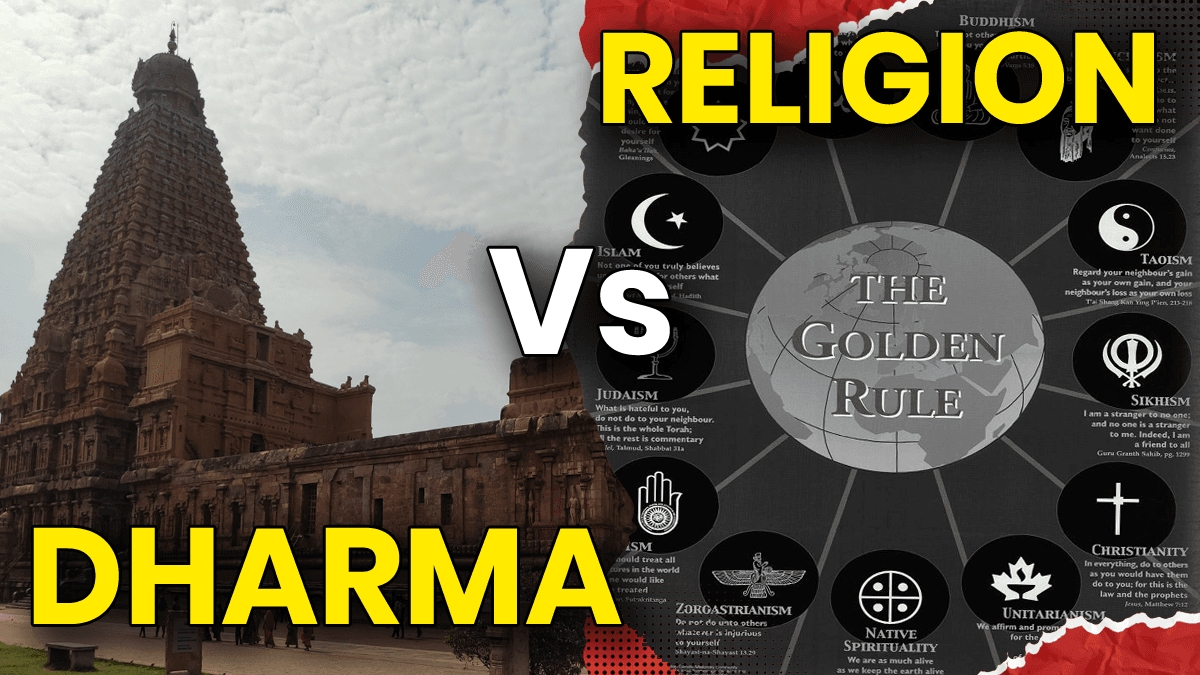
Understanding Dharma vs Religion is not just a linguistic or academic exercise. It is a gateway to unlocking a civilizational worldview that may offer the world a more inclusive, balanced, and deeply human path forward.
🕉️2. What is Dharma? – The Civilizational Core of India
The word “Dharma” is derived from the Sanskrit root “Dhri”, meaning “to uphold”, “sustain,” or “support.” It is the principle that holds the cosmos together—the essence of order, harmony, and truth.
But Dharma is not a rigid code—it’s dynamic, contextual, and deeply personal.
📌 Core Dimensions of Dharma:
Cosmic Dharma – Natural law, the moral framework of the universe
Social Dharma – Duties based on age, stage (ashrama), and role (varna)
Personal Dharma – One’s unique conscience and path
Situational Dharma (Yuga Dharma) – What is right depends on time and context
In the Bhagavad Gita, Krishna urges Arjuna to perform his Swadharma (individual duty), even if painful—because Dharma sustains not just society but the soul’s evolution.
🧠 Dharma is not what you believe—it is what you do and how you align with truth.
✝️3. What is Religion? – The Western Framework
The English word “religion” comes from Latin “religare”, meaning “to bind or tie back”. In Western thought, religion is often structured around:
A single prophet or messiah
A holy book (e.g., Bible, Quran)
Doctrines and tenets
An institutionalized body (church, clergy)
Faith as the primary requirement
This structure created organized religion—a defined system of beliefs and behaviors that members must accept or be excluded from.
Unlike Dharma, religion is more exclusive: you must believe in one version of truth, often denying all others.
4. Dharma vs Religion: Key Philosophical Differences
| Aspect | Dharma (Indian View) | Religion (Western View) |
|---|---|---|
| Origin | Eternal (Sanatana) | Time-bound, with a founder |
| Approach | Experiential, inclusive | Belief-based, exclusive |
| Path | Multiple valid paths | One “true” path |
| Authority | Multiple texts, flexible | One holy book, fixed |
| Focus | Duty, harmony, responsibility | Faith, obedience |
| Salvation | Moksha (liberation) through karma & wisdom | Heaven/hell via faith in God |
| Community | Pluralistic, open | Defined boundaries (believers/non-believers) |
| Inclusivity | Recognizes all paths as valid | Often missionary, exclusive |
⚖️ While religion says “this is the only way,” Dharma says “there are many ways, suited to different beings.”
5. Sanatana Dharma: Not Just “Hinduism”
The term “Hinduism” is not native to India—it is a colonial label. The correct, indigenous term is Sanatana Dharma – the eternal way of life.
Sanatana Dharma is not a “religion” in the Western sense. It is a civilizational flow, rooted in the Vedas, yet evolving through the Upanishads, Puranas, epics, and even folk traditions.
It is:
Non-dogmatic
Experiential (through meditation, devotion, karma)
Deeply philosophical (Tat Tvam Asi, Aham Brahmasmi)
Culturally rich and regionally diverse
🌐 One can be a Shaivite, Vaishnavite, Shakta, or follow no deity at all—and still be within Sanatana Dharma.
6. Dharma in Daily Life – Real World Examples
Dharma isn’t confined to temples or scriptures—it’s expressed in daily life and inner intent.
🙏 Examples:
A mother caring for her child: Dharma of compassion
A soldier protecting the nation: Dharma of duty
A student sincerely studying: Dharma of learning
A farmer sowing with love: Dharma of nature
In each of these, truth is lived, not preached.
7. Why the Dharma Lens Is Vital in Modern Times
In a world torn by identity politics, religious conflict, and climate crisis, Dharma offers a holistic, inclusive lens:
💡 What Dharma Teaches the Modern World:
Ethics are contextual, not rigid
Diversity is natural and necessary
Focus on inner transformation, not outer conversion
Unity with nature, not dominion over it
Embrace of dialogue, not dogma
🕊️ When the world sees Dharma as responsibility, not religion, it may rediscover spiritual sanity.
8. Misunderstandings Between Dharma and Religion
Much conflict between civilizations arises from projecting the religious model onto Dharma. This leads to:
Labeling Sanatana Dharma as “polytheistic” or “idolatrous”
Assuming there is a central “Hindu Church”
Misunderstanding temples as “places of worship” rather than energy centers
Western scholars often mistake myth as falsehood, while in Indian thought, myth (Itihasa) is symbolic truth.
🔍 To understand India, one must view it through the lens of Dharma, not religion.
9. The Path Forward: Expanding Global Consciousness
As the world explores mindfulness, yoga, non-duality, and interfaith harmony—Dharma is silently rising.
India’s message is not to replace religions but to expand understanding. Dharma accepts all traditions, as long as they lead to truth, peace, and self-realization.
Let Christians become better Christians, Muslims more mindful Muslims, and atheists more ethical atheists—through Dharma, not against it.
🌏 Dharma can be the bridge between faiths, between the sacred and the secular, between the East and the West.
10. Conclusion: Dharma – The Soul of Bharat
Dharma is not just a concept—it is the civilizational soul of Bharat. It teaches that:
Truth is not singular
Each being has a role in the cosmic order
Inner awakening matters more than outer belief
Unity comes from harmony, not homogeneity
In a world increasingly divided by belief, race, and ideology—Dharma offers a path of integration, balance, and spiritual evolution.
Let us not reduce it to religion.
Let us rediscover it as a living philosophy, a guiding force, and the deepest gift of India to the world.
🕉️ Dharma is not what separates us. It’s what sustains us.
11. Frequently Asked Questions (FAQs)
2. Is Hinduism a religion or a Dharma?
👉 Technically, what we call Hinduism is better described as Sanatana Dharma—the eternal way. It is not a single religion but a civilizational system encompassing philosophy, rituals, ethics, and culture. The term "Hinduism" is a colonial label; Sanatana Dharma is inclusive, pluralistic, and experiential, not dogmatic.
3. Can a person be religious and still follow Dharma?
👉 Yes. Dharma doesn't reject religion—it transcends and includes it. A Christian, Muslim, Buddhist, or atheist can all follow Dharma by living ethically, performing their duties with integrity, and contributing to harmony in society.
4. Does Dharma have a single holy book like religions do?
👉 No. Dharma draws from a vast body of texts—like the Vedas, Upanishads, Mahabharata, Ramayana, and Smritis—but none are considered the only source of truth. Dharma respects diversity of thought and allows multiple valid interpretations.
5. How is Moksha in Dharma different from Salvation in Religion?
👉 Moksha means liberation from the cycle of birth and death, achieved through self-realization and detachment. Salvation in most Western religions involves being saved by divine grace through belief. Dharma emphasizes self-effort, karma, and inner transformation, whereas religion may focus on faith alone.
6. Is Dharma only for Hindus or Indians?
👉 No. Dharma is a universal principle. It applies to all beings, regardless of nationality or belief. It is about aligning with truth, fulfilling duties, and living ethically—not about religious identity.
7. Why is understanding Dharma important today?
👉 In a world divided by dogma, binary thinking, and religious conflict, Dharma offers a unifying perspective. It helps us respect different paths, embrace ethical pluralism, and live in harmony with nature and one another.