
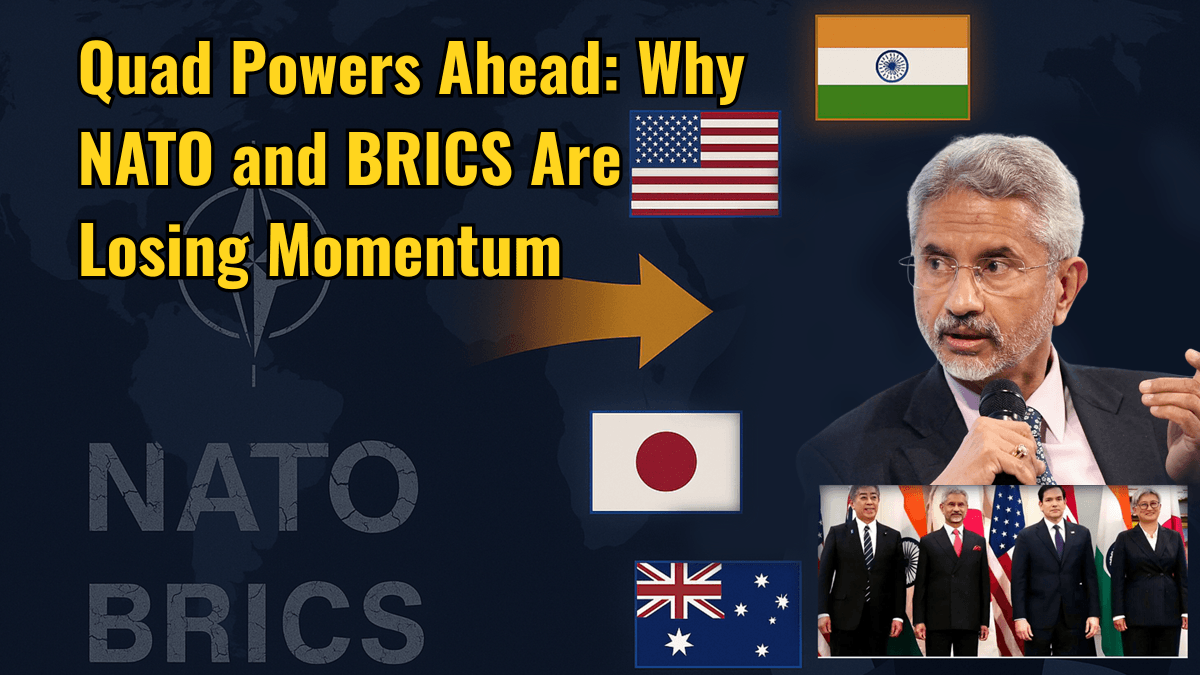
The flurry of recent plurilateral meetings—from NATO to BRICS to the Quad—signals a world scrambling to adapt. The Quad’s foreign ministers (U.S., India, Japan, Australia) met in Washington most recently, following NATO’s summit and ahead of the upcoming BRICS leaders’ gathering in Brazil. Yet, beneath the surface, both NATO and BRICS are showing signs of slowing effectiveness.
NATO’s Fatigue and Empty Promises
NATO’s latest joint statement was strikingly brief. While it labeled Russia a “long‑standing” threat, it sidestepped mention of the Israel–Iran conflict and instead focused on unrealistic defense spending targets—urging members to hike their budgets from 2 % to 5 % of GDP, despite most just barely hitting 2 % this year. Ironically, the U.S. lags behind even this benchmark, with Europe scrambling to find funds for both defense and economic infrastructure amid sluggish EU growth projections (around 1.5 % in 2026). With EU economies barely keeping pace, NATO’s grand ambitions risk falling flat—prompting skepticism from non‑attendees like South Korea, Japan, and Australia. Some diplomats cite tariff disputes, others call out differing legal interpretations, especially in Japan’s case.
Quad: Focused, Practical, and Purpose‑Driven
By contrast, the Quad’s Washington meeting centered on action, not rhetoric. U.S. Secretary of State Marco Rubio clarified that this is about more than security—it’s about education, business, supply chains (including rare earths), and emergency aid. India, for its part, doubled down on both freedom of choice and counter‑terrorism—specifically naming Pahalgam—while calling out China’s assertiveness in the South China Sea.
Notably, the Quad outlined four concrete focus areas:
Maritime and transnational security
Economic growth and supply chain resilience
Critical/emerging technologies
Humanitarian aid & emergency response
On the ground, initiatives are already unfolding: Quad logistics exercises near India and Hawaii, a U.S.–India Working Group on aircraft carriers (May 20 in Delhi), and a new Coast Guard observer mission (July 2). Progress is tangible.
Challenges Ahead
That said, headwinds persist. Australia’s Prime Minister Albanese drew criticism for favoring a China visit over one in Washington. Meanwhile, AUKUS is sputtering as trade with China surges. Japan, wary of U.S. tariffs and the Middle East conflict, increased its defense spending by 9.7 %, yet remains uncertain about full U.S. backing. Regional trade pacts with South Korea and China—driven by tariff pressures—signal a shift in economic alliances. India–China tensions continue, highlighted at the Shanghai Defence Ministers Meeting where India refused a joint statement that overlooked its concerns.
BRICS Shows Signs of Slowdown
BRICS, too, is losing steam: President Xi is skipping the current summit. Expansion into BRICS+ may be impressive on paper, but internal divisions and lack of strategic cohesion hinder true impact.
Quad: The Only Momentum Builder
With NATO’s vague distractions and BRICS’s drift, the Quad stands apart. It’s the only plurilateral working with clarity, execution, and speed. Though still informal—no secretariat yet—and cautious about permanent structures, it’s finding workarounds. India’s bilateral ‘2+2’ foreign/defense pacts with each Quad member blend coordination and flexibility. Defense ministers have met. The PM attends BRICS—but India remains deeply engaged in Quad logistics and maritime efforts, cementing its global stature.
Despite political theatrics elsewhere—from former President Trump to tariff threats—Washington’s administration is visibly investing in the Quad and wants it moving fast. And right now, that momentum seems real.
Key Takeaways
NATO is struggling with empty goals and missed opportunities.
BRICS conserves profile but lacks actionable unity.
Quad emerges as the only grouping delivering concrete steps.
For India, balancing between BRICS and Quad means playing both economic and strategic cards—and right now, Quad is playing better.
FAQs:
2. Why is NATO perceived as losing momentum?
NATO still has unmatched military capability, but faces growing internal caution and reluctance among members, especially smaller European states, to engage decisively—such as on Ukraine or tougher stances—leading to a blur in unified direction
3. What challenges does BRICS face?
Despite its vast population (3.3–3.5 billion) and rising GDP ($60 trillion vs. NATO’s ~$40 trillion), BRICS lacks cohesion in areas like military coordination and unified strategy. Expansions (e.g., to Egypt, Iran, UAE) may further dilute consensus.
4. What makes the QUAD more agile and effective?
The QUAD is an informal, flexible dialogue reinforced by regular meetings, practical collaborations (vaccine caps, cyber frameworks, maritime coordination), and a shared vision of a “free and open Indo‑Pacific”—excluding binding commitments, so it avoids NATO-style inertia.
5. How might global power balance shift?
The world appears to be evolving toward multipolarity, with newer strategic groupings like QUAD steering security in the Indo-Pacific. Meanwhile, BRICS drives economic influence, and NATO retains defense supremacy—yet each bloc faces unique internal limits .
2. Why is NATO perceived as losing momentum?
NATO still has unmatched military capability, but faces growing internal caution and reluctance among members, especially smaller European states, to engage decisively—such as on Ukraine or tougher stances—leading to a blur in unified direction
3. What challenges does BRICS face?
Despite its vast population (3.3–3.5 billion) and rising GDP ($60 trillion vs. NATO’s ~$40 trillion), BRICS lacks cohesion in areas like military coordination and unified strategy. Expansions (e.g., to Egypt, Iran, UAE) may further dilute consensus.
4. What makes the QUAD more agile and effective?
The QUAD is an informal, flexible dialogue reinforced by regular meetings, practical collaborations (vaccine caps, cyber frameworks, maritime coordination), and a shared vision of a “free and open Indo‑Pacific”—excluding binding commitments, so it avoids NATO-style inertia.
5. How might global power balance shift?
The world appears to be evolving toward multipolarity, with newer strategic groupings like QUAD steering security in the Indo-Pacific. Meanwhile, BRICS drives economic influence, and NATO retains defense supremacy—yet each bloc faces unique internal limits .