
Introduction: A Different Kind of Power Is Rising
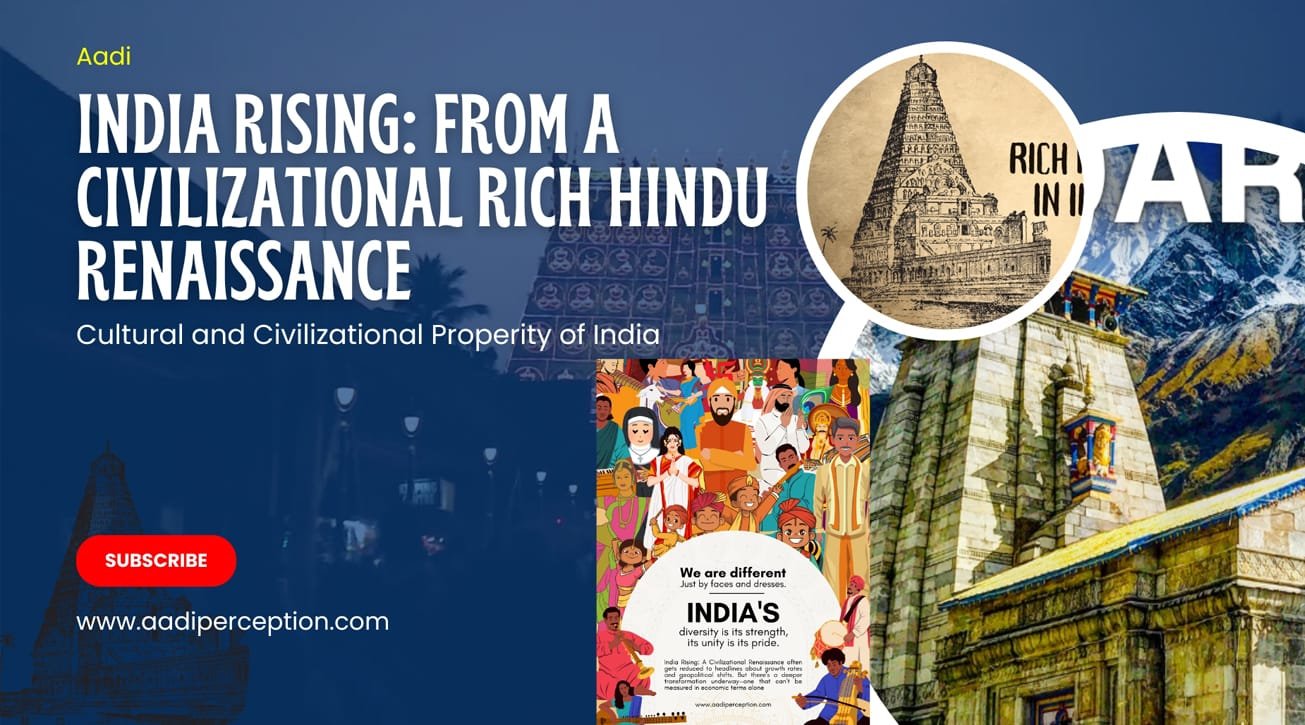
In a world obsessed with GDP figures, defense budgets, and global alliances, the story of India Rising: A Civilizational Renaissance often gets reduced to headlines about growth rates and geopolitical shifts. But there’s a deeper transformation underway—one that can’t be measured in economic terms alone.
India is not just rising; it is reawakening. Unlike many modern powers built on military expansion or economic domination, India’s resurgence is rooted in something far older and more enduring: its civilizational soul.
Power doesn’t always roar through missiles or money. Sometimes, it whispers through philosophy, resilience, and quiet confidence. India’s rise is not just about becoming a superpower—it’s about becoming India, fully, unapologetically, and with clarity.
This is not merely a success story of a developing country; it’s a civilizational renaissance—the return of a worldview that has survived millennia, that celebrates diversity, that innovates with empathy, and that acts with strategic patience. In this post, we’ll explore the deep roots of India’s rise and why the future may look more Indian than we expect.
I. The Unbroken Soul: Civilizational Continuity
What Is Civilizational Continuity?
Civilizational continuity means more than just a country’s survival—it means the preservation of its philosophical essence, cultural memory, and core identity despite the challenges of time. Most modern nations are defined by borders or political systems. India, however, is defined by a living, breathing civilization that stretches back over 5,000 years—and it’s still evolving.
India’s Ancient Soul
Empires have risen and fallen, ideologies have come and gone, but India’s soul—the essential worldview shaped by sages, poets, mathematicians, and philosophers—has remained alive.
India was not built in a conference room. It was revealed over centuries, across sacred rivers, Himalayan hermitages, and village courtyards. What binds Indians is not race or language, but a shared philosophical inquiry—a quest for truth, purpose, and harmony.
While many modern countries look outward to define themselves, India has always looked inward: Who am I? What is this life? How do we coexist with all life? These questions have endured invasions, colonialism, and attempts at cultural erasure.
Resilience Through History
From Alexander to the Mughals, from the British Empire to post-independence turbulence, India has endured. Not just physically, but spiritually. Its traditions were never wiped out; they simply adapted, absorbed, and transformed. The Upanishads survived the sword. The Vedas survived the plunder. And through oral transmission, temple art, and folk stories, the civilizational memory stayed intact.
This resilience is not accidental—it’s by design. It is the power of a culture that doesn’t just resist change but integrates it while keeping its core alive.
II. Strategic Patience: The Slow and Steady Ascent
What Is Strategic Patience?
In our age of instant gratification, patience is underrated. But India has mastered the art of strategic patience—not as passive waiting, but as a deep understanding of timing, rhythm, and evolution.
India didn’t try to “catch up” with the West by abandoning its values. It walked its own road, even when that road looked chaotic or slow.
India’s Bold Choice of Democracy
After centuries of colonial rule, India could have chosen dictatorship, theocracy, or even fragmentation. Instead, it chose the world’s most ambitious experiment in democracy—with all its messiness, contradictions, and beauty.
At the time, this was radical. Millions of people, many of them illiterate, were entrusted with shaping their own future. This was not just political—it was civilizational faith. A belief that dharma (righteousness) must emerge from the people, not just from power.
The Resilience of Indian Democracy
Indian democracy has been tested—emergency rule, violent conflicts, social fractures, and economic shocks. But it has held together, even when stronger systems have collapsed elsewhere. It is not perfect, but it is alive, dynamic, and self-correcting.
This isn’t because India is lucky—it’s because its civilizational DNA supports multiplicity, debate, and compromise. Where others see chaos, India sees the dance of many truths.
III. Embracing Chaos: The Power of Pluralism
The Complexity of India
India is a nation of 1.4 billion arguments. Multiple religions, languages, castes, cuisines, and ideologies exist under one flag—not because they must, but because they can.
Contradiction isn’t a bug in India’s system—it’s a feature. Here, it’s possible to worship a formless absolute and 33 crore gods at the same time. To revere both Buddha and Krishna. To speak 22 official languages and hundreds more at home. This is not chaos. It is pluralism on steroids.
Diversity as Strength
Most nations try to eliminate contradiction to find order. India thrives in it. This pluralism isn’t easy—but it builds muscles of tolerance, empathy, negotiation, and resilience. It teaches people to live with difference, not fear it.
The Indian way of being is about holding many truths together—spiritual, material, local, universal. And from this balance comes a unique form of social cohesion.
Identity as a Tapestry, Not a Cage
In India, identity is fluid. A person can be a Tamil, a Hindu, a vegetarian, an engineer, and a Bollywood fan—all at once. There’s no pressure to flatten oneself into a label.
This ability to weave contradictions into wholeness is what keeps the civilization alive. It creates a people who are simultaneously rooted and adaptable.
IV. Innovation Rooted in Tradition: A Unique Model
The Ancient and the Modern, Together
India’s innovation doesn’t come from rejecting the past. It comes from transforming it.
From Ayurveda to quantum computing, from Sanskrit grammar to AI ethics, India shows that tradition is not a burden—it’s a launchpad. The digital revolution is happening in a nation where temples still ring bells and villagers still chant mantras.
Indian Innovation: Not Flashy, But Formidable
What makes Indian innovation unique is its purpose. It’s not just about profit or speed. It’s about inclusion, frugality, and dignity. From Aadhaar to UPI, India’s digital infrastructure has brought entire populations into the economy with dignity, not dependence.
This is “jugaad” thinking at scale—not crude shortcuts, but elegant hacks born from constraint and compassion.
Technology With Empathy
India’s future-facing mindset is anchored in deep philosophy. It knows that tech without values is dangerous. So the innovations that emerge here often carry a moral compass—a desire to serve, not just scale.
This blend of sacred and scientific is what makes India’s rise so different. It’s not loud. It’s not aggressive. But it is transformative.
V. On the Global Stage: Emanating, Not Competing
India’s Voice of Clarity
When India speaks today—whether at the G20, the UN, or in BRICS—it speaks with clarity, confidence, and a sense of civilizational purpose. This is not a voice trying to mimic others. It’s a voice rooted in hard-won wisdom.
India doesn’t claim moral superiority. But it does offer an alternative model—one that values balance over dominance, dialogue over dictation, and coexistence over conquest.
Not a Superpower, But a Civilization Power
India doesn’t want to be a hegemon. It wants to be a civilization-state—a guiding light, not a dominating force.
Its rise is not about replacing one empire with another. It’s about ending the era of empires altogether.
India’s message is simple: There’s another way to be powerful—one that doesn’t demand submission, but inspires cooperation.
Conclusion: Becoming India Again
India’s rise is not about finally becoming like the West. It’s about finally becoming itself.
It is a story written not in skyscrapers or fighter jets—but in the everyday courage of a billion people walking their path, honoring their past, and shaping their future.
India is rising because it remembered who it is. It stopped apologizing for its chaos, its complexity, and its contradictions—and began to celebrate them.
This is not just a comeback. This is a civilizational renaissance. And it’s just beginning.
What Can We Learn From India’s Rise?
🌱 Know who you are. Civilizational strength begins with identity.
⏳ Be patient with your growth. Strategic patience beats quick wins.
🤝 Celebrate complexity. True strength lies in pluralism.
🔥 Innovate from your roots. The future belongs to those who remember.
🌍 Rethink power. Influence isn’t always loud—it can be luminous.
📚 Want to explore more?
Read: “The Argumentative Indian” by Amartya Sen
Watch: “Bharat Ek Khoj“ (series by Shyam Benegal)
Explore: https://aadiperception.in for original blogs on culture, politics, and civilizational insights.
If this message resonated with you, share it. Let others see that India’s rise isn’t just a statistic—it’s a signal of what the world might become.
🙏 Namaste. Jai Hind.